Showing posts with label Coretta Scott King Award. Show all posts

Wednesday, November 8, 2017

The Crossover

The Crossover book cover.jpg


Alexander, K. (2014). The Crossover. New York, NY: Houghton Mifflin Harcourt.

Summary
Twin brothers Jordan and Josh compete on and off the basketball court even though they are on the same team on and off the court. They are growing apart socially partly due to a girl Alexis.  The growing agonizing erupts in a fight between the two brothers.  This puts a strain on the family as well.  Suddenly their father passes shocking the boys who partly viewed him as invincible due to his former pro basketball career.  After his death, the boys realize the fragility of life and the importance of family being there for each other. 

Commentary
This novel is written in prose. It helps make the reading quick. It is rare to read a book with African-American male protagonist that aren't fighting the police, drugs, or gangs. Both the boys are good students with professional parents. The issues are not typical teen issues but for readers of a particular demographic their are familiar themes. Dealing with the police as black males, healthy diet and seeing doctors are common themes for black families. Alexander presented these in his novel without beating readers over the head with it.




Connections to text
The realistic fiction genre features characters in real settings going through real life issues. In YA books the characters are teens in middle or high school dealing with friendship, love, changing family dynamics.  These are all in the novel The Crossover. The fact that the main characters are male and not a teenage girl which is a change of typical YA.

Monday, November 6, 2017

X A Novel

Image result

Shabazz, I. (2015). X: A Novel. Somerville, MA: Candlewick Press.

Summary
If anyone can write a semi-biographical account of Malcolm X's early life it is his daughter. She knew him and and access to others that knew him well. Malcolm Little  lived in Lansing, Michigan.  His father died when he was six. As a young teen, he started to get into trouble for playing pranks at school and stealing fruit from a store and a neighbor's yard.  He is moved to a foster home because the government believes his mother is not well and cannot take care of him. Eventually all of his sisters and brothers are moved to a foster home.  When Malcolm is 16, he decides to move to Boston with hsi half-sister. The big city immediately captivates him. He is drawn into the criminal life because he finds it so easy and he can make money quickly. He goes from job to job eventually become a porter on a train and discovers Harlem. He moves up  there and become even more of hustler. After getting in big trouble with a dangerous number runner, Malcolm's friend Shorty comes to rescue him and take him back to Boston. Waiting for him there is Sophia. She is the woman Malcolm cannot not shake because she is white and it is considered forbidden and that excites him. Sophia and her sister get Malcolm and Shorty involved in their robbery operation.  A foolish move gets them caught. Malcolm takes a watch he stole to get fixed and the jeweler calls the cops. Once in prison, Malcolm Little must come to terms with all the mistakes he has made in his life. He reevaluates what his father has taught him. He comes to term with is role in the United States and realizes he cannot depend on others but cannot blame others either. It ends with Malcolm Little becoming Malcolm X.

Commentary
The book coves Malcolm's early life in detail. Even though some stories and characters were made up or compiled of a collection of events and people it reads like a true biography. If you are familiar with the James Baldwin biography on Malcolm X. This serves as a perfect prequel.  the names and places are all true. Ilyasah Shabazz did a good job including events that explains why the Malcolm became the leader we know him for in his later life. 

Connections


Connections to text
Biographies should be true to the time they cover. The United States at the time of the novel was extremely divided racially. This novel can serve as a history lesson for young readers who were not alive in the 1940s. Readers will get a better understanding of the character Malcolm and how and why he became the man to lead people.

Wednesday, April 26, 2017

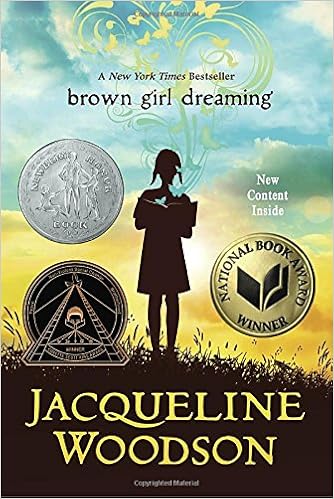
Brown Girl Dreaming


Woodson, J. (2014). Brown Girl Dreaming. New York, NY: Puffin Books.


This book reminds me a little of Crossover since it is written in free verse and autobiographical. It reminds me a little of How I Discovered Poetry since they are both accounts on growing up as black girls in America. Then there was also similarities to The Watsons Go to Birmingham. Both have black families that live in the north and are exposed to new culture when they travel to the south.Also the characters' mothers in both books are originally from the south but have been brought to the north through marriage to raise their families.

Jacqueline Woodson tells the story of being born in Ohio and moving to South Carolina while still very young.  She was raised by her grandparents pretty much while her mother went to New York to try to make a living. Her mother returns with a new baby in tow to bring Jacqueline and her siblings back to New York to live with her. Now they must readjust to living in a big city; much different than the country life they had in South Carolina. She writes of spending her summers down south and returning to New York. She shares stories of learning to read, having her hair pressed, going to church and understanding how African-American were expected to "act" when living in the south as opposed to living up north.  She meets a girl who will become a life long friend and becomes embraced by another family and their culture. She shares about living during the civil rights era as a young child. For her it was hearing about it from family members or on the news not really understanding what the fighting was about. Both because of age and perhaps because of location, New York, she was saved from some of the harsher realities of that time. If she had stayed in South Carolina with her grandparents her experiences would have been different.

I enjoyed this book so much.  It took me a long time to read it and I finally figured out it was because I kept reading the passages over and over again.  It must have been my subconscious not wanting me to stop reading it. This should be on a list for upper elementary or middle school grades. The structure of the story shows students that there is more than just one way to write. The way the tone changes from chapter to chapter and sometimes within a chapter shows students that writing is not one dimensional especially when you are writing about your life. I can see why this book is a National Book Award Winner. It is a wonderful piece. 

Tuesday, April 11, 2017

The Watsons Go to Birmingham


Curtis, C ( 1995). The Watsons Go To Birmingham -1963. New York, NY: Yearling.

The United States was a different place in 1963. The southern states still practiced systematic discrimination of people of color. This novel addresses a family raising children during this time. The Watson family consists of a father, mother, their two sons Byron and Kenny and their daughter Joetta. The live in Detroit far away from the hatred in the south. The mom is from Birmingham and still has family there mainly her mother.  In the summer of 1963, the family takes a trip down to Birmingham. The kids experience what southern living is like complete with southern dialects, swimming in lakes, magnolia trees, and the extreme heat.  The trip brings a change in everybody. Byron, who normally is a troublemaker in Detroit, become more respectful and responsible. The mom who usually is the head of the household becomes a daughter again when around Grandma Sands. And Kenny who is usually very dependable begins to get careless and a bit reckless.

A near death experience for two characters change the family forever. The kids experience the ugly side of America and have to decide how to deal with it. The parents have to come to terms with the fact that their children came so close to something they have worked so hard to keep them from. But they realize their family is a lot stronger together than they ever could be if they are separated. They come to understand that they can depend on each other.

This is a fiction story written as a personal narrative. I thought it was an actual biography or memoir. Christopher Curtis includes a real historical event to bring a feeling of reality to the readers.The recollection of this and the response of the characters brings a sense of familiarity to readers who were alive during that time. He uses vivid imagery and quick witted dialogue to bring the setting and characters to life. Teachers can use this novel  to show how to writers use powerful vocabulary in their writing. It can also be included to show how a personal narrative is written 

Sunday, April 2, 2017

Crossover


Alexander, K. (2014). Crossover. New York, NY: Houghton Mifflin Harcourt.

Josh and Jordan (JB) Bell are twin brothers, the sons of former Professional European basketball player Charles (Chuck) "Da Man" Bell. They are preteens who have done pretty much everything together and are all the sudden growing apart. While they both love basketball, other things start to become just as important as it does with most boys. Other things like girls, love, crushes, and jealousy. Another theme throughout the book  is trust. Without giving too much away the narrator and his father both must deal with some trust issues to be able to heal fractures that are starting in the family unit.

The story is written in free verse prose. Kwame Alexander uses the voice of a preteen African American boy to produce a wonder story on family love and growing up.  You do not have to love basketball to appreciate this book and be moved to tears.

Friday, March 3, 2017

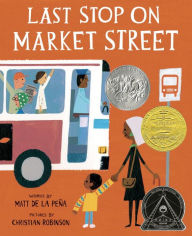
Last Stop On Market Street


De la Pena, M. (2015). Last Stop on Market Street. New York, NY: GP Putman Sons.

CJ is not too excited about having to go with his nana. He questions her on everything. Why do they have ride a bus? Why do they have to wait in the rain? Why? Why? His nana has a way of making the simplest of explanations sound wonderful and does a great job of making CJ and the reader appreciate all that is around them. Things like the sounds in nature, trees in the rain and a bus that breathes fire. The reader finds out the characters are going to a soup kitchen or homeless shelter to volunteer. Showing the family may not have a lot. They don't have a car, or can buy expensive mobile music players but they still can help others. 

I love this book for so many reasons. The message of charity for others is so important for young children. Not only is a great book to show how to appreciate your surroundings and look for the good things in every situation, but it is also full of great writing. When and author can write a kid's picture book with awesome writing and the young children can still understand, it is a must have.  I have used this book to teach about similes, descriptive language, strong verbiage, and complex sentences. We have used it to discuss different perspectives. Even though there are only 2 main characters, there are plenty of others that the readers sees in the pages as they read. The characters are so diverse; black, white, young, old, handicapped, different socio economic, and more.  You are presented with all of these variety without it being preached to you.  Everyone is just part of the book just like they would be part of the community. They just exist. 

Friday, February 10, 2017

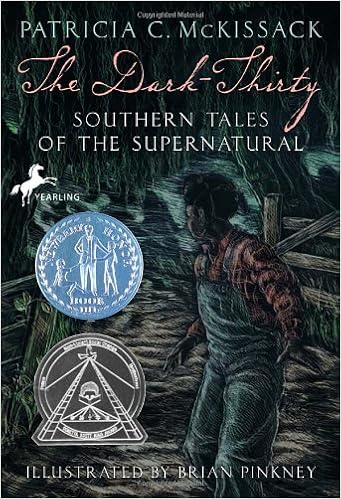
The Dark-Thirty: Southern Tales of the Supernatural


McKissack, P. (1992). The Dark Thirty: Southern Tales of the Supernatural. New York, NY: Alfred K Knopf, Inc.

This is a collection of spooky stories set in the backdrop of the southern states. Most of the stories deal with a protagonists, who are black, exacting revenge on antagonists, who are white.  The revenge comes after the black characters have died due to the white characters' selfishness or evilness. It comes in the form of hauntings by the ghosts of these protagonists.  Slaves escaping from plantation, men being wrongly blamed by the KKK, slaves creating voodoo dolls to harm their masters, these are some of the plots in these stories. There are some stories that deal with childhood fears like haunted chicken coops, evil spirits entering houses, and imaginary conjured brothers. The settings take the readers from pre emancipation to the civil right era.  This book won Author's Award for the year. The writing isn't that spectacular. It is pretty straight forward with not a lot of build up but they are short stories. If they were longer they could be their own novel.  I was expecting something a lot more suspenseful but this was written over twenty-five years ago.  My expectations for spooky have been shaped by a lot of paranormal and horror films over the years. It is a change to see African-Americans get revenge on racist characters. 

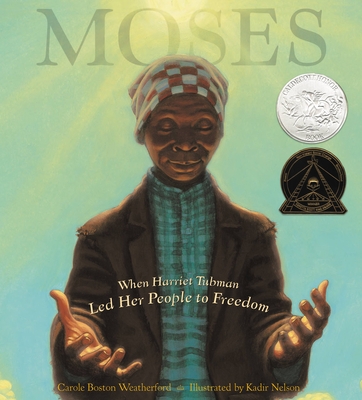
Moses: When Harriet Tubman Led Her People to Freedom


Weatherford, C. (2006). Moses: When Harriet Tubman Led Her People to Freedom. New York, NY: Hyperion Books.

While the title implies this book is about Harriet Tubman leading slaves to freedom, it is more about her own escape. Harriet was born a slave, and one night the Lord tells here it is time for her to be free. She risks her life and health hiding from slave catchers and dogs and walking for long periods of times through tough terrain sometimes barefoot. Harriet's strength and faith keep her going even when she doubts herself and ability. There are people that help her along the way, but we never see them as Harriet is the focus of the book. Once she arrives to her destination, she comes to the conclusion that she must return to help free her family. We know that she returns many times to free others. She becomes a conductor in the Underground Railroad. 

The pictures are gorgeous. But I wouldn't expect anything else from Kadir Nelson. This is why he won the Illustrator Award for this book.  What I noticed is that with the exception of 2 pages, most of the  pictures are dark. Harriet is shown predominately in the dark or in shadows. This makes sense because she was escaping from slavery and that usually wasn't done in the daytime. Slaves had to sneak out in the cover of darkness. It is not until Harriet reaches Philadelphia that we see her drawn in bright colors. 

It is written in narrative mixed with verse. The words of Harriet are in italics much like they are lyrics. Which may imply that she is singing them. Slaves did sing quite a bit to hide their plans from slave masters. The words of God are large and written across the page. This shows the reader the importance of the message and the messenger.

Moses is another book suitable intermediate grades for African American History month. Primary teachers may find it good for read alouds but they will have to do a lot of explaining. 

Firebird


Copeland, M. (2014). Firebird. New York, NY: G. P. Putnam's Sons.

2015 must have been the year to celebrate dance. Books on Misty Copeland and Josephine Baker won awards or honors. This book is a story meant to motivate. The subtitle explains Ballerina Misty Copeland Shows a Young Girl How to Dance Like the Firebird. Misty convinces a brown skinned dancer that she can be a star dancer just like herself. She explains that it takes hard work, practice, and determination to rise to the top of your field. 

The pictures stretch across the page. Christopher Myers shows the dancer with extended legs and arms emphasizing the long lines of a dancer. The text is short on each page. This book would be good for students to read themselves. Teachers could use this to show figurative language in stories. 

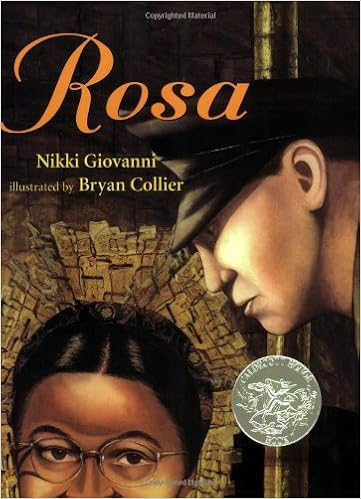
Rosa


Giovanni, N. (2005). Rosa. New York, NY: Henry Holt.

Rosa is an historical account of the day that Rosa Parks was arrested. Many student read a short blurb about her refusing to give up her seat to a white man but this gives more to her story. It may be fictionalized but it does explain her motivations as well as the motivations of others that lead the civil rights movement.

Rosa was a seamstress who was on her way home to cook dinner for her husband. She was sitting in a seat she had every right to sit in. She was arrested for standing up for what she felt was unjust. This book shows how such a simple gesture had a ripple effect on the city, state, and country.

Teachers could use this book for the obvious black history connection. As a civics lesson, teachers can show that just because something is a law doesn't make it right. It also is a good mentor text to show personal narratives. Every body has a story on a event from their life. Students do not need to write their whole life story to have something interesting to share.

I also think it is interesting that Nikki Giovanni left the actual arrest out of the story. She doesn't need to include it since her audience knows what happens and how Rosa's story ends. It is an interesting way to introduce to young student writers to not spend so much time on what the reader already knows.  Get to the point of the story.

This was a Illustrator Award Winner. Each picture takes about 3/4 of the two page spread. The text runs down the left or right side of the edge. This allows the pictures to be the focus if the book is used as a read aloud. The colors are not bright. They are rather muted with a lot of mustard and earth tones. The subject matter isn't a happy point in the Untied States' history so maybe that is why bright colors were not used.

Towards the end, two pages fold out to extend the size of the book. The content of these pages is the the nonviolent protest of bus boycott. The pages stretch to show how long the walkers stretched through the city.

How I discovered Poetry


Nelson, M. (2014). How I Discovered Poetry. New York, NY: Dial Books.

This is a collection of poems written as a narrative of the author's or poet's life as a young girl in the 1950s trying to find a place to fit in; trying to find her purpose in life. At first, I thought they were all true but in her note at the end she says some of the poems are fictionalized but still based on her life experiences none the less. They read like a young girl going through military moves and daydreaming about life possibilities. They also read like a young black girl going through what life is life for an educated young a black girl; too black for white kids not black enough for the black kids. She doesn't miss anything in her memories of growing up black. It is hard being the only black student or child surrounded my white children. Almost every black child has been asked to have their hair touched.  Dealing with uninformed children and "well meaning" teachers is a hard task and it stays with young African-Americans; proof shown in that Nelson was still affected by it enough to write about it as an adult.

This was an Author Honor book. It is beautifully written. I wouldn't include it in a primary library, but I would in a middle and or high school library.  Teachers of fourth and fifth graders could read some of the poems to show examples of narrative poetry or poems written from the first person point of view. 

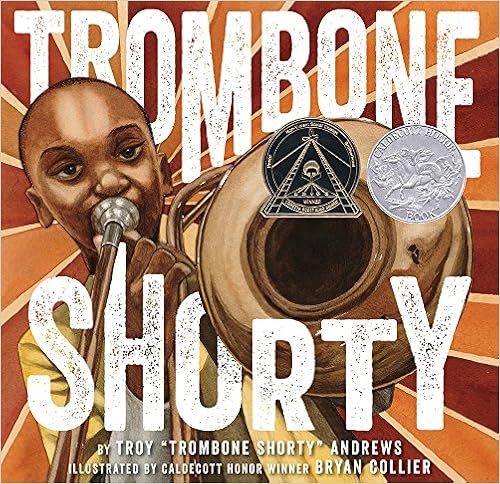
Trombone Shorty


Andrews, T. (2015). Trombone Shorty. New York, NY: Harry N. Abrams, Inc.

An autobiography on the life of Troy Andrews. Troy writes how he became known as Trombone Shorty. He was born in New Orleans raised in the Treme neighborhood known for its rich culture. He got his musical talent honestly. Many in his family were musicians.  He found a old trombone and began to use it. He and his friends joined in the parades through out the city. A chance encounter with Bo Diddley at the New Orleans Jazz and Heritage Festival set the course for Andrews' stardom. He now has his own band and helps other kids with musical dreams like he once had. 

This book was honored for its illustrations. It is no mistake that Bryan Collier used different mediums to create the illustrations. There are drawings, cut outs, magazine or newsprint clipping all put together to make one picture after next. New Orleans' food and music were created by combining different styles to make something new.  Consequently,  I think the illustrator made a conscious choice to create the pages by combing different elements. Thus making the pictures a tribute to what makes New Orleans great.


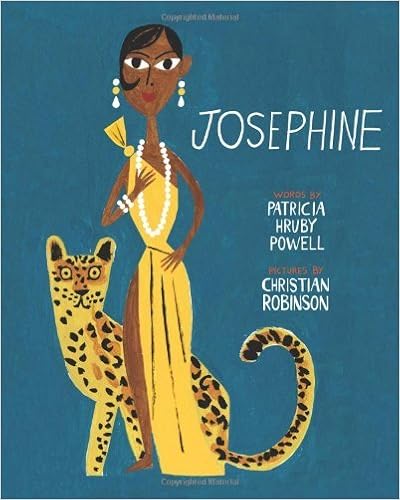
Josephine The Dazzling Life of Josephine Baker


Hruby Powell, P. (2014) Josephine The Dazzling Life of Josephine Baker. San Francisco, CA Chronicle Books.

This books takes readers through the life of the star Josephine Baker. I will admit I am a little bias with this subject I even named by dog after her. The book starts with her being born poor in St. Louis and moves on to her fame in Europe. She helped her mother wash clothes but was fascinated with the black vaudeville shows. She became part of the act when she joined The Jones Family and then at thirteen became a part of The Dixie Steppers touring with them. She was relegated to being their dresser. They traveled across the racial divided south and Josephine got to see segregation and experience in by performing not being able to visit white only theaters. After The Dixie Steppers stopped touring, she went to New York to be part of the first all-black show on Broadway. However she did get picked to be part of the show. She ended up being a dresser again. Josephine still learned all the dances and waited for an opportunity. When a dancer didn't show up she filled in and stole the show. She went on to dance in other shows but still was upset at the laws in the United States that wouldn't let her eat with white people and made her enter through back doors. Eventually she was invited to go to Paris and be part of La Revue Negre. Josephine found success in Europe charming everyone. She fame brought wealth. She still could not get respect in America. During World War II Josephine helped by joining the Parisian Red Cross and eventually became a spy to help defeat the Nazis. She performed for US soldiers and demanded that the black troops be allowed to sit in the front with the white troops. She married three times and during her third marriage she adopted twelve children from across the world. Showing how strong of a believer she was in in loving all. Raising the large family and extravagant spending led to her becoming broke. Josephine had to begin to tour again. This time she was welcomed in America. She still loss her house and had to depend on the the kindness of some of her friends to help her and her family. She ended up dying after celebrating a return to the Paris stage.

Josephine Baker was born in St. Louis poor and not expected to rise to much. This story is illustrates how her determined nature was the catalyst to her to overcome racism. The book includes direct quotes along with text written in verse. This biography is an easy read aloud for primary grades to understand and it's written in a manner that will keep their attention. I like the change in font between the author's verse and the direct quote. Putting Josephine's words in cursive seems appropriate since she was such a elegant figure. Like all Coretta Scott King Award winners and honorees this is a worthy book to include in a library that strives to be inclusive.

The book was an Illustrator Honor book.  The pictures are rather simple and "elementary" in nature. But it would appeal to younger students. There isn't a lot of other details added to each page.  And if Josephine is the focus of the text then she is the main picture also.  I like this style of drawings. They are sophisticated but still a little goofy just like the real Josephine Baker. 


Mufaro's Beautiful Daughter


Steptoe, J. (1987). Mufaro's Beautiful Daughters. New York, NY: Amistad, Harper Collins.

A take on the traditional Cinderella. This one is based in an African village. Mufaro has two daughters Manyara and Nyasha who are both very pretty but opposites in every other way. Manyara is mean to her sister, making sure to only do it when her dad is not watching. She teases her telling her that one day she will be queen and her nice younger sister will be her maid. Nyasha, the nice younger sister, is unbothered by her sister's negativity. She sees the good and beauty in everything even in a snake that shows up in her garden one day. 

One morning a message comes from the nearby city that the king is looking for a wife. Mufaro believes either one of his daughters are worthy to be queen. He tells them to prepare to go to the city tomorrow.  Manyara sneaks away during the night trying to get to the king first. In a forest, she runs into a small boy and refuses to give him food when he asks. She then meets a woman who tries to give her advice. Manyara doesn't care to take the woman's advice to heart and laughed at a grove of trees and ignored a man with his head under his arm. 

Then next morning the wedding party that Mufaro put together notices that Manyara has disappeared. They go on towards the city to meet the king without her. Nyasha encounters the same people her sister did earlier but she being nice reacts differently. She gives the young boy food, gives the old woman some sunflower seeds, and doesn't have the same encounter the same reaction from the grove of trees. When she sees the city she is in awe of its beauty. Then her sister runs up to her and their father horrified. Manyara tells them there is a five headed snake who scared her by telling her of all her rudeness.  Nyasha continues on anyway and sees the snake from the garden. He tells her that he the king and he was the young boy in the forest as well as the old lady. Because Nyasha had been kind to them, the king would marry her. 

The wedding preparations were made. Nyasha married the king and Manyara became her maid. 

This was also a recipient of the illustrator award. The pictures are gorgeous and would delight young children during a read aloud. They help tell the story.  As a teacher, I have used this story when teaching how to compare and contrast different text. Teachers can also use it to show how authors include evidence in text to show character traits. It as a good story that has stood the test of time of being a worthy story that entertains young people. It is also a worthy book because of its diversity in characters. The African characters and setting offer diversity to children's literature. 

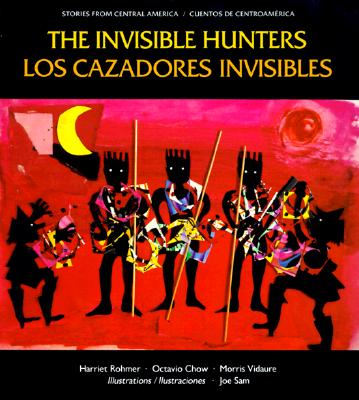
The Invisible Hunters/Los Cazadores Invisibles


Rohmer, H., Chow, O., Viduare, M. (1988). The Invisible Hunters/Los Cthwesazadores Invisibles (Stories from South America). New York, NY: Children's Book Press

This book was a honored due to the illustrations. The artwork is bold and reminds me of art that would be found in a museum. After looking at it longer, I think the illustrations remind me of cave drawings.  The pictures don't include detailed faces. Just dark silhouettes going through motions.

The story focuses on a group of hunters in Nicaragua. They are looking for wild pig to hunt. They run into a magical vine that they discover can make them invisible if they are holding it. The hunters realize they can use this to their advantage while hunting. The vine said they may use pieces from it to help hunt as long as they promise not to sell the meat and only use sticks to hunt not guns. They promise. Their hunt goes well and the people of the village are fed well. They come to understand the power of keeping their promises to help others prosper.

Then the Europeans come and influence the hunters to sell them the meat. Soon their greed at getting meat for the Europeans gets the better of them and they forget what they promised the vine and begin to hunt with guns to get more meat quickly. The meat supply runs scarce and there isn't enough to feed the village. The hunters turn ugly to the villagers they use to help.  The hunters have forgotten their promise to the Dar and have forgotten that there are more fortunate if they help others in their community rather than looking out for themselves. 

One day they return from a hunt and the villagers turn from them. The elders tell them they are invisible even though they are no longer holding on to the vine. They return to the vine and ask for help but get none. Now they are invisible and are kicked out by the village as the elders tell them they are no longer welcome. They now are said to roam up the river begging to be visible again.

Other than the obvious message on how it is not good to be self serving, this story also explains the negative influence the Europeans had on native or indigenous people. The natives had survived for many years by living in a community that relied on different people to do different roles. When people do not do their roles the community does not survive. The Europeans coming in and changing the religion, beliefs, and rituals of the people in these groups caused them to weaken. When Europeans came in and invaded those groups already weak could not survive. 

Teachers could use this to teach citizenship lessons as well as show history. It makes it real simple to see how a change in people can affect others. This book is also bilingual. It would be nice in a school or classroom library at a dual language, ESL, or bilingual school. 

Each Kindness


Woodson, J. (2012). Each Kindness. New York, NY: Nancy Paulsen Books.

There is a new girl in Chole's class. She has older worn clothes. Chloe and her friends act rudely towards here not inviting her to play with them and ignoring her attempts at initiating a friendship. Pretty soon the new girl Maya just plays by herself. Then one day she doesn't show up to school. Chloe's teacher teaches a lesson on kindness and Chloe realizes she has been less then nice to the new student. She waits to make it up to Maya but she never returns and the teacher later informs them that Maya's family has moved. Chloe realizes she will never get a chance to make it up to Maya.

This book is told from the  first person point of view. Young readers will be able to identify with the narrator having regrets about her behavior. Most children have done something to someone that they wish they could take back. Some young people may identify with the other character Maya because they were once a new person in a class. Even though we don't get to see Maya's thoughts we can sympathize with someone being rejected by others. This would be a good book to read aloud during Kindness week at elementary schools. Counselors could find it useful when teaching lessons on how to make friends or how to be a good friend.

This was an Coretta Scott King Author Honor book. Ms Woodson tells a important story in a way that children can understand. The pictures are pretty also. The cover shows a girl standing by herself. She looks alone and sad. The readers can tell this won't be a happy story. Using the title and cover, teachers can have a good discussion on predictions. "Why is the girl alone? What does it mean by Each Kindness? Was someone unkind to the girl on the cover?" Some illustrations are a two page spread but there isn't a lot going on in the picture. I think this helps narrow the readers focus on the subject. For instance on the page where Maya is jump roping, she is the only thing on the two pages. This exemplifies that she was really alone. No one was playing with her. The last page as well has one character in a scene spread over a double page spread. Chloe is small compared to the whole scene of the pond and trees around her. This helps the reader understand how lonely she feels while remembers how unkind she treated Maya. I thinks it shows her in a state of self reflection and that she is not happy with herself.