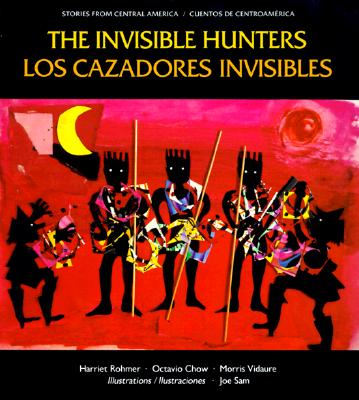
Rohmer, H., Chow, O., Viduare, M. (1988). The Invisible Hunters/Los Cthwesazadores Invisibles (Stories from South America). New York, NY: Children's Book Press
This book was a honored due to the illustrations. The artwork is bold and reminds me of art that would be found in a museum. After looking at it longer, I think the illustrations remind me of cave drawings. The pictures don't include detailed faces. Just dark silhouettes going through motions.
The story focuses on a group of hunters in Nicaragua. They are looking for wild pig to hunt. They run into a magical vine that they discover can make them invisible if they are holding it. The hunters realize they can use this to their advantage while hunting. The vine said they may use pieces from it to help hunt as long as they promise not to sell the meat and only use sticks to hunt not guns. They promise. Their hunt goes well and the people of the village are fed well. They come to understand the power of keeping their promises to help others prosper.
The story focuses on a group of hunters in Nicaragua. They are looking for wild pig to hunt. They run into a magical vine that they discover can make them invisible if they are holding it. The hunters realize they can use this to their advantage while hunting. The vine said they may use pieces from it to help hunt as long as they promise not to sell the meat and only use sticks to hunt not guns. They promise. Their hunt goes well and the people of the village are fed well. They come to understand the power of keeping their promises to help others prosper.
Then the Europeans come and influence the hunters to sell them the meat. Soon their greed at getting meat for the Europeans gets the better of them and they forget what they promised the vine and begin to hunt with guns to get more meat quickly. The meat supply runs scarce and there isn't enough to feed the village. The hunters turn ugly to the villagers they use to help. The hunters have forgotten their promise to the Dar and have forgotten that there are more fortunate if they help others in their community rather than looking out for themselves.
One day they return from a hunt and the villagers turn from them. The elders tell them they are invisible even though they are no longer holding on to the vine. They return to the vine and ask for help but get none. Now they are invisible and are kicked out by the village as the elders tell them they are no longer welcome. They now are said to roam up the river begging to be visible again.
Other than the obvious message on how it is not good to be self serving, this story also explains the negative influence the Europeans had on native or indigenous people. The natives had survived for many years by living in a community that relied on different people to do different roles. When people do not do their roles the community does not survive. The Europeans coming in and changing the religion, beliefs, and rituals of the people in these groups caused them to weaken. When Europeans came in and invaded those groups already weak could not survive.
Teachers could use this to teach citizenship lessons as well as show history. It makes it real simple to see how a change in people can affect others. This book is also bilingual. It would be nice in a school or classroom library at a dual language, ESL, or bilingual school.

No comments:
Post a Comment