Showing posts with label folktale. Show all posts

Friday, April 28, 2017

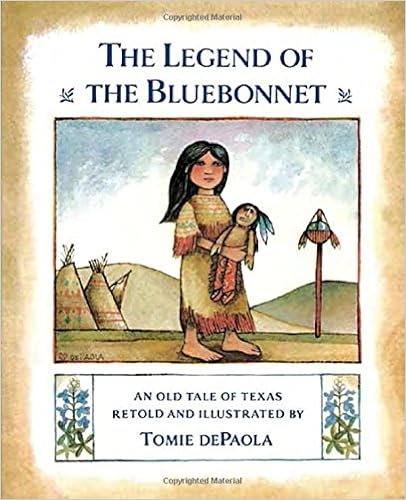
The Legend of the Bluebonnet


DePaola, T. (1983). The Legend of the Bluebonnet. New York, NY: Penguin Young Readers Group.

A tribe of Comanche are suffering through a devastating drought. She -Who-Is-Alone is member of this tribe. The shaman tells the tribe the Great Spirits say they have been selfish and taken from the land.They must make a burnt offering of their most prized possessions to pay the land back. No one is willing to part with their possessions. She-Who-Is-Alone burns her doll as an offering to the Great Spirits. It is the only thing she has left from her family who has died in the drought. The next morning the Native Americans wake up to a field of blue flowers. The same color blue as the feathers in the girl's doll. The Great Spirits send rain and the drought is over. The girl is than called One-Who-Dearly-Loved-Her-People.

As legends do, this story gives a fictional account on a natural occurrence. This tale explains why Texas is showered with bluebonnets every spring. In Texas school, it is a must read. Teachers use it as part of their study on legends or as and fun read during a Texas unit. The painting's colors are warm and true to the southwest art. they way characters dress and scenery are true to the Native American culture.  

Friday, February 10, 2017

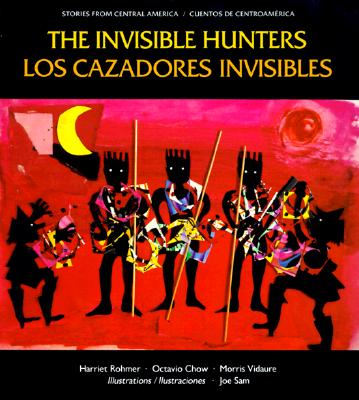
The Invisible Hunters/Los Cazadores Invisibles


Rohmer, H., Chow, O., Viduare, M. (1988). The Invisible Hunters/Los Cthwesazadores Invisibles (Stories from South America). New York, NY: Children's Book Press

This book was a honored due to the illustrations. The artwork is bold and reminds me of art that would be found in a museum. After looking at it longer, I think the illustrations remind me of cave drawings.  The pictures don't include detailed faces. Just dark silhouettes going through motions.

The story focuses on a group of hunters in Nicaragua. They are looking for wild pig to hunt. They run into a magical vine that they discover can make them invisible if they are holding it. The hunters realize they can use this to their advantage while hunting. The vine said they may use pieces from it to help hunt as long as they promise not to sell the meat and only use sticks to hunt not guns. They promise. Their hunt goes well and the people of the village are fed well. They come to understand the power of keeping their promises to help others prosper.

Then the Europeans come and influence the hunters to sell them the meat. Soon their greed at getting meat for the Europeans gets the better of them and they forget what they promised the vine and begin to hunt with guns to get more meat quickly. The meat supply runs scarce and there isn't enough to feed the village. The hunters turn ugly to the villagers they use to help.  The hunters have forgotten their promise to the Dar and have forgotten that there are more fortunate if they help others in their community rather than looking out for themselves. 

One day they return from a hunt and the villagers turn from them. The elders tell them they are invisible even though they are no longer holding on to the vine. They return to the vine and ask for help but get none. Now they are invisible and are kicked out by the village as the elders tell them they are no longer welcome. They now are said to roam up the river begging to be visible again.

Other than the obvious message on how it is not good to be self serving, this story also explains the negative influence the Europeans had on native or indigenous people. The natives had survived for many years by living in a community that relied on different people to do different roles. When people do not do their roles the community does not survive. The Europeans coming in and changing the religion, beliefs, and rituals of the people in these groups caused them to weaken. When Europeans came in and invaded those groups already weak could not survive. 

Teachers could use this to teach citizenship lessons as well as show history. It makes it real simple to see how a change in people can affect others. This book is also bilingual. It would be nice in a school or classroom library at a dual language, ESL, or bilingual school. 

Saturday, February 4, 2017

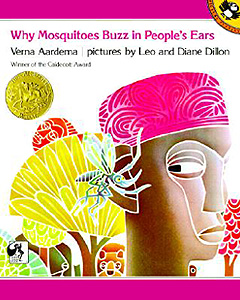
Why Mosquitoes Buzz in People's Ears


Aardema, V. (1975). Why Mosquitoes Buzz in People's Ear. New York, NY: Dial Books.

In this African folktale Verna Aardema, takes readers through a forest to see a giant chain of events. It all starts with an iguana getting bugged by a mosquito. He doesn't want to hear the insect talk anymore so he puts sticks in his ears. Then a python tries to speak to the iguana, but since he can't hear, he keeps walking. The python becomes fearful thinking the iguana is mad at him and is trying to hurt him. He slithers into a rabbit hole to hide. The rabbit seeing this gets scared and runs off. A crow sees the rabbit running and sends out a warning call to the other animals in the forest. A monkey hears this call and assumes a beast is coming to attack the animals. He bounds through the trees and inadvertently knocks an owlet out of the nest and it dies.

This upsets the mother owl so much, she refuses to do her job, waking the sun. So the forest stays under a night sky. The animals have a meeting to find out why the night is lasting so long. King Lion asks the Mother Owl. She says she is too upset to wake the sun because the monkey killed one of her babies. The animals proceed to unravel the story and end up at realizing this is all the mosquito's fault. They decide to punish the bug. He hears this and goes into hiding. He goes around and whining in people's ears asking if the other animals are still mad at him. Thus the reason why mosquitoes are always buzzing around people.

As all folktales do, this one explains an occurrence in nature. The illustrations are bright and not the typical drawings. Children do like this story. I have read it every year when we study traditional literature. The onomatopoeia in the story is a unique way to show "animal speak". Teachers could use this as a lesson to show why it is always important to not lie or how one lie can cause a series of bigger problems.  I like to use it to show sequence and cause and effect in literature. 

Thursday, February 2, 2017

John Henry


Lester, J. (1994). John Henry. New Your, NY: Dial Books.

This picture book on the folk hero John Henry is more than just a folktale. It is an example of how authors can expertly transform readers to any place in time. Quality figurative language is used through out the book.  The author, Julius Lester, includes personification, hyperbole, and metaphors to tell his story. Students would enjoy the descriptive language and get a good sense of how strong supposedly John Henry was. It would be good to use during a unit on legends or folktales as well as during writing to show how a biography can be written.

John Henry was said to be extremely strong. From birth he commanded a the world take notice. He was faster than any horse and stronger than any machine. John Henry loved to compete to show off his ability. He used his strength to help build roads construct railroads by breaking through rocks and boulders (which are more like mountains). This competitive nature eventually ends up causing his death.