Showing posts with label children's literature. Show all posts

Friday, April 28, 2017

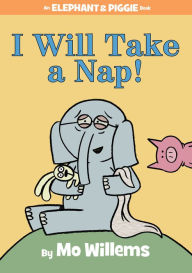
I Will Take a Nap


Willems, M. (2015). I Will Take a Nap! New York, NY: Hyperion Books.

Gerald and Piggie return for another story. Gerald is tired, very tired and cranky. His buddy Piggie decides to join him for a nap but inadvertently keeps Gerald up while he gets rest. But is Gerald really up or was the whole thing a dream? Kids have to look at the illustrations on the page very carefully to catch on to what is happening in the story. 

I enjoy Mo Willems' Elephant and Piggie books. The characters show how friendship has its ups and downs but in the end love for each other wins out. This book is a clever story in that it is a story inside a story. When I read it to my class, they all loved the "turnip head"line. And the surprise ending was pleasing especially to those who figured it out before the story was over.  

Where the Wild Things Are


Sendak, M. (1963). Where the Wild Things Are. New York, NY: Harper & Row.

When you have a "fresh" mouth and are driving your mother crazy, you get sent to your room. This is what happens to Max in this classic children's story. The rest of the tale is Max's imagination. He sails away to an island of true wild things. After they do their best to scare Max, he tames them with a stare in the eyes. They make him their king because truly is is the wildest of them all. The group of them then proceed to go around the jungle being a rowdy bunch. After a while, Max stops the group and send them to bed without supper. Sounds like Max has had some experience with this punishment. He leaves the island and returns to his bedroom to find a hot dinner waiting for him.

Children love this story. Teachers add it to their classroom library and it quickly becomes a favorite. Kids can relate to being sent to their room or time out when all they were doing was having some fun. Adults can relate to having those days when the children are running wild and driving them crazy. This story shows how a writer can take realistic fiction and blend it smoothly with fantasy. It also shows that having a vivid imagination is not thing bad thing.

Sunday, April 2, 2017

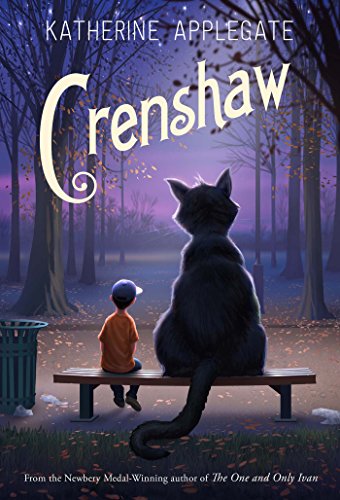
Crenshaw


Applegate, K. (2015). Crenshaw. Harrisburg, VA. Feiwel and Friends.

In Crenshaw, the readers are introduced to Jackson and rather extraordinary cat, Crenshaw. The relationship soon become evident that the cat is Jackson's imaginary friend. The reason why Jackson's friend has appeared now is evident to the reader but not to Jackson. His family is going through a very tough time and Jackson feels like he has to be strong for everyone else but never is honest with himself or others around him. 

The news reports on unemployment and homeless numbers and some specialized shows focus on the adults who have lost their jobs and homes, but there are few reports on how children are affected.  As teachers we have to teach students regardless of what their home life is like. This novel is a reminder of what some of our students have on their plate. They are suffering though tough times to and the one constant in their life is usually school. They may switch school frequently, a fear of the character in this book, but they are usually always enrolled in one eventually. 

This is good book for upper elementary students. This novel could lead to classroom discussions on how to open up and express their feelings.  Teachers and counselors could use to teach compassion and build empathy in students. 

Friday, March 3, 2017

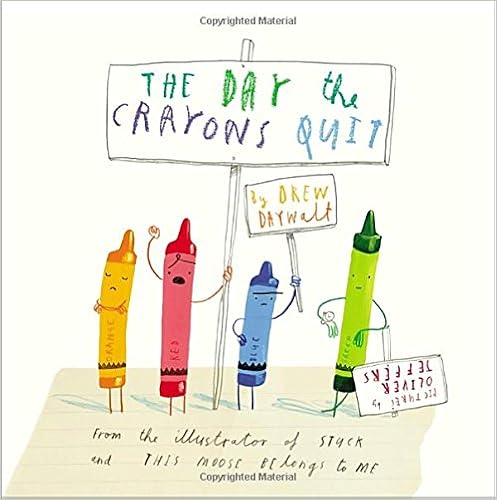
The Day The Crayons Quit


Daywalt, D. (2013). The Day the Crayons Quit. New York, NY: Penguin Young Readers.

Duncan's crayons have had enough! They are tired of being used up and not having their feelings considered.  Red feels overused. Beige feels like he is never used to color anything worthwhile. Blue is worn down. What is a boy to do? The final page lets us see Duncan used the crayons to color an unconventional picture. The green was used for water. The pink made a dinosaur. The sky was a bright yellow.  Duncan showed that art doesn't have to follow rules.

Every time I would read this I would think the author must have been sitting around and saw a crayon just laying around and wondered what it would do if it could talk.  He came up with a great conversation for the crayons. It is a great book to read to young readers. The story is great but the pictures of the crayons as little people are bound to please too. 

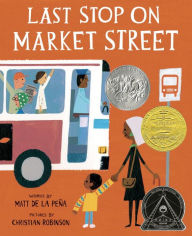
Last Stop On Market Street


De la Pena, M. (2015). Last Stop on Market Street. New York, NY: GP Putman Sons.

CJ is not too excited about having to go with his nana. He questions her on everything. Why do they have ride a bus? Why do they have to wait in the rain? Why? Why? His nana has a way of making the simplest of explanations sound wonderful and does a great job of making CJ and the reader appreciate all that is around them. Things like the sounds in nature, trees in the rain and a bus that breathes fire. The reader finds out the characters are going to a soup kitchen or homeless shelter to volunteer. Showing the family may not have a lot. They don't have a car, or can buy expensive mobile music players but they still can help others. 

I love this book for so many reasons. The message of charity for others is so important for young children. Not only is a great book to show how to appreciate your surroundings and look for the good things in every situation, but it is also full of great writing. When and author can write a kid's picture book with awesome writing and the young children can still understand, it is a must have.  I have used this book to teach about similes, descriptive language, strong verbiage, and complex sentences. We have used it to discuss different perspectives. Even though there are only 2 main characters, there are plenty of others that the readers sees in the pages as they read. The characters are so diverse; black, white, young, old, handicapped, different socio economic, and more.  You are presented with all of these variety without it being preached to you.  Everyone is just part of the book just like they would be part of the community. They just exist. 
Thursday, February 2, 2017

John Henry


Lester, J. (1994). John Henry. New Your, NY: Dial Books.

This picture book on the folk hero John Henry is more than just a folktale. It is an example of how authors can expertly transform readers to any place in time. Quality figurative language is used through out the book.  The author, Julius Lester, includes personification, hyperbole, and metaphors to tell his story. Students would enjoy the descriptive language and get a good sense of how strong supposedly John Henry was. It would be good to use during a unit on legends or folktales as well as during writing to show how a biography can be written.

John Henry was said to be extremely strong. From birth he commanded a the world take notice. He was faster than any horse and stronger than any machine. John Henry loved to compete to show off his ability. He used his strength to help build roads construct railroads by breaking through rocks and boulders (which are more like mountains). This competitive nature eventually ends up causing his death.

Frederick


Lionni, L. (1967). Frederick. New York, NY:Alfred A. Knopf.

Everyone can contribute something to make society better. That is the message in the picture book by Leo Lionni. Frederick may not gather food or prepare for winter like the other mice, but when the supplies run low and the group needs a morale boost, Frederick's stories and imagination keep the other mice entertained during the winter season.

Sharing this book with young readers shows them that everyone has a part in a community whether it is a family, class, and or the world. No matter how small, each individual can contribute something. It also teaches tolerance for those that don't follow what others deem normal. The person who may be "inattentive" or "daydreaming" may indeed be absorbing the Earth's beauty in his or her own unique way and just waiting for the right time to share his or her vision with others.

Tuesday, January 31, 2017

Frog and Toad Are Friends


Lobel, A. (1970). Frog and Toad Are Friends. New York, NY: Harper Collins Publishers.

"Once upon a time there were two good friends". That is how each of these short stories in this book could start. Each story shows the reader how these two character are there for each other from helping the one who is not a morning person, to looking for a lost button, and helping one get over their embarrassment. Just the typical stuff that good friends do for each other. 

I have a personal connection to this book. It was one of the first books I remember reading on my own.  I read it over and over again. The vocabulary and content is good for emerging readers. Parents would enjoy reading it to or with their child.


Monday, January 30, 2017

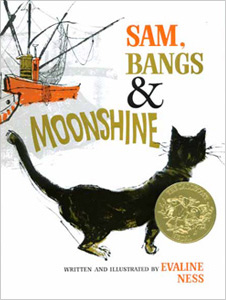
Sam, Bangs, & Moonshine


Ness, E. (1966). Sam, Bangs, & Moonshine. New York, NY: Henry Holt and Company.

This is a story about a girl with a problem with lying. Samantha (Sam for short) lives in a fishing town with her father  a fisherman and her cat Bangs. She has told stories or fibs to all the people in the town. However there is  young boy who believes her stories and one day goes out on a quest based on one of her lies. It ends up putting him and Sam's cat in grave danger. 

This would be a good story for parents to share with young children about possible repercussions that could result from lying.  Even though I felt Sam wasn't lying so much as she just was a child with a vivid imagination, the story does teach a good lesson for children that there comes a time when they must start telling the truth.

The word choice would make this a great mentor text to teach students how to use vivid words to describe a scene. Phrases like " menacing rumble of thunder" and "grey ribbed curtain of rain" paint the picture of a terrible storm taking place. 

The art work is unique being that only three colors are used; gold, black, and gray. They are complimentary and don't take away from the story that is taking place.