Showing posts with label Newberry. Show all posts

Wednesday, November 8, 2017

When You Reach Me

When You Reach Me by Rebecca Stead


Stead, R. (2009). When You Reach Me. New York, NY: Random House

Summary

Miranda is a middle school student and has had Sal as a friend for most of her life. They stop being friends after Marcus punches Sal in the stomach one day.Miranda meets a homeless man on the street who gives her messages that she soon realizes are the places where notes are left for her.  She befriends AnneMarie and Colin. They begin working at a deli but soon discover the owener is prejudiced against blacks so they leave.  Meanwhile, Marcus tries to apologize to  Sal. Sal runs into the street to avoid Marcus. The homeless man saves Sal from being hit while in the street. Miranda soon realizes that that was what the man was here for. To save Sal. She then realizes that the homeless man was a grown up  Marcus. He traveld in time to save Sal.

Commentary
It is a very interesting book and I can see how young readers like age 9 and 10 would enjoy it.  Their isn't mush of a unrealistic element until the time travel is introduced.  But the book on the whole is reasonable and entertaining. It is not confusing with new society and new rules. The book starts out as a mystery as Miranda tries to figure out who is leaving her notes and what the person wants her to do.  It ends surreal with a magic element of time travel.

Connections


Booklist Editor's Choice award and School Library Journal Best Book

Connections to text
This book isn't the teen drama type of YA literature.  It is more geared for younger teens or tween.  It starts out with many elements of realistic fiction; the characters could be real, the problem could really happen, the setting is believable. But that changes with the introduction of time travel. That changes this novel to fantasy fiction. The magical element does imply that maybe it can be considered science fiction but I don't think enough is included to warrant that classification.

Friday, April 28, 2017

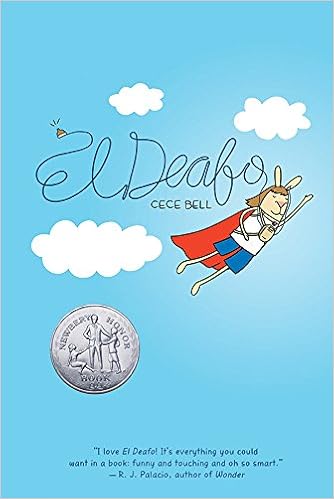
El Deafo


Bell, C. (2014). El Deafo. New York, NY: Amulet Books.

This is a autobiography written in a graphic novel format. Cece Bell was born healthy but as a young child she got meningitis and became deaf. She now must adjust to living in a hearing world. She goes to a school with other hear impaired students and learns how to lip read. By first grade she starts a new school in a new town. She attends a regular elementary and starts to wear the Phonic Ear. This device allows her to hear her teachers better and means she doesn't have to watch their lips.  Through the years, Cece makes friend and looses friends. She does her best to fit in without having her hearing impairment stand out. She is embarrassed by anyone who shows her special attention because of it especially when they attempt to use sign language. Cece refuses to learn it. She thinks it will make people stare at her.  Cece has the life of a typical young girl: slumber parties, first day of school jitters, and crushes. When her classmates realize her ability to hear her teacher no matter where she is located in the school because of the Phonic Ear, she becomes the class superhero. Cece realizes that her condition may not be a bad thing worth hiding from others after all.

This is another book that shows the power of living with a disability. These students just want to be included. They don't want any special treatment but come to realize that sometimes it is needed. This novel would be a good read for teachers and school counselors to include in lessons on acceptance and tolerance.

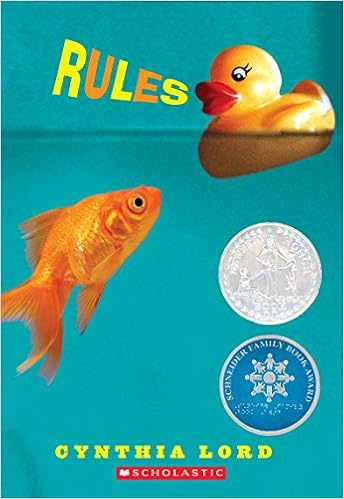
Rules


Lord, C. (2006). Rules. New York, NY: Scholastic Press.

Catherine is a babysitter not unlike other 12 year-olds. But her charge is her 8 year old autistic brother. She takes the role of watching him serious and has a series of rules to keep him in line and to help him function in public. Catherine the narrator in this book explains that every thing must be taught to her brother and he functions better when things are presented as rules. At David's occupational therapy sessions, Catherine strikes up a friendship with Jason. He is about her age maybe older and in a wheelchair. He uses word cards and a communication book to talk. Catherine draws pictures and Jason compliments her on one of her drawings. Their next visit she offers to create some word cards for him. 

At this time, there is a new family moving in across the street. Catherine is excited because the family includes a girl her age. She hopes they can become best friends. She is mortified at their first meeting because David has a breakdown. Eventually they strike up a friendship and Kristi seems to be sympathetic to Catherine's situation with her brother. 

Over the summer Catherine grows closer to Jason. Kristi wants Catherine to go to a dance with her and Ryan, a boy Catherine can't stand. When Catherine objects because she doesn't have a date, Kristi suggests Jason not knowing that Jason is non verbal and in a wheelchair.  Catherine is too embarrassed to tell Ryan and Kristi the truth so she makes excuses. Turns out the dance is the same day as Jason's birthday party and he invites her to that. So that becomes Catherine's excuse to not attend the dance. At the party, Jason finds out about the dance and asks Catherine to go with him. When she declines, he accuses her of being embarrassed of him.She denies it but he know its true. Catherine leaves the party with David and after some soul searching calls Jason's house and invites him to the dance.

Once there she introduces Kristi to David. Kristi is surprised to see Jason and Catherine apologizes for not be straightforward with her. Kristi leaves slightly upset. Catherine and Jason go and dance a big move for Catherine since she doesn't like to dance especially in public.

In the end Catherine learns to accept her brother warts and all and realize that their relationship is something special.

It must be hard to be a child and have so much responsibility put on you. And siblings of handicapped potentially have a lifetime of care giving ahead of them. When the parents get too old or pass it will be up the the siblings to take care of the person. Catherine is no different than any other 12 year old.She loves her brother but at times is embarrassed by his condition and just wishes for a reprieve every now and then. This is compounded when she meets and begins a relationship with Jason. Its the same feeling. She enjoys him but still is worried what others will think of the two of them if they are seen in public by people she knows. Students need to read this book. They need to understand that having a person that in your family that is different is nothing to be ashamed of. But it is understandable and common if you have feelings of exasperation at times. It is a growing process have an autistic person in your family and as much as Catherine tried, there isn't a rule book. 

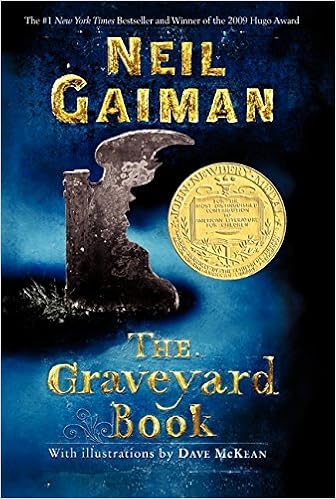
The Graveyard Book


Gaiman, N. (2008). The Graveyard Book. New York, NY: Harper Collins Publishers.

A family is murdered. That is how this story begins. The lone survivor, a baby, crawls to a graveyard. He is protected from the killer by the inhabitants and eventually adopted by them. He is granted free reign of the graveyard . This books has ghosts, werewolves, vampires, witches, and goblins. The young boy, Bod, short for Nobody, has various encounters with all of these as he learns to navigate in the world of the dead. He eventually convinces his caretaker Silas to let him attend venture out of the cemetery and attend school.But that doesn't end well. He uses his powers he has learned to defeat some school bullies but this brings unwanted attention.

Some time later, an old friend Scarlet returns. She was a childhood friend of Bod whose parents moved to Scotland for her father's teaching job. She has met a historian who now lives in the house that Bod's family was killed. Being that the man Mr. Frost is now a friend of the family, Scarlet asks him to do some research on the murders for her friend Bod. She invites Bod over to the house to meet Mr.Frost. Turns out it is Jack Frost the man who has been trying to kill the boy. There is a prophecy that Bod will destroy the the society that Jack belongs to, Jack of all Trades. 

Scarlet and Bod escape to the graveyard when Jack reveals his true intentions. The members of the Jack society chase them. Once in the graveyard, three of the Jack fall to their death. Bod somehow manages to trick Jack Frost into declaring himself the Sleer's master and the Sleer wraps him up and takes him goodness know where. Silas comes and erases Scarlet's memory of all the traumatic events.He then convinces Scarlet's mother to return to Scotland.

When the book ends, a 15 year old Bod is growing out of the ability to travel around the graveyard and do what he used to like seeing ghosts. Silas gives him some money and a passport and Bod leaves his old life behind.  

I did not enjoy this book. I am not a fan of vampires, witches,horror and ghost stories. This novel had all that. It was a hard read because the action was very slow in the beginning. The Old English language was hard to understand as well. I don't understand how a book dealing with someone trying to murder someone is thought of as children's literature. 

Good Masters! Sweet Ladies! Voices From A Medieval Village


Schlitz, L. (2007). Good Masters! Sweet Ladies! Voices From a Medieval Village. Cambridge, MA: Candlewick Press.

A book of monologues from characters in the Middle Ages. Each speech gives insight on a child's life during this time. There is the nephew of a lord and son of a doctor. On the other end of the spectrum there are speeches from the son of the town's miller and a runaway. The readers also hear from the daughter of a lord and a girl who assaults her out of fit of exhaustion and jealousy. Each speech gives insight on life during that time and how it differs based on the family's position in society but also that there are many things that these kids have in common.

The author writes that she wrote this book so that students at her school could gain an understanding of life during the 1200s. It is essentially a history lesson. The language is true to the time period. Even with footnotes, a lot the words and phrases would be difficult for young children to understand. It is more for students in middle school.

Wednesday, April 26, 2017

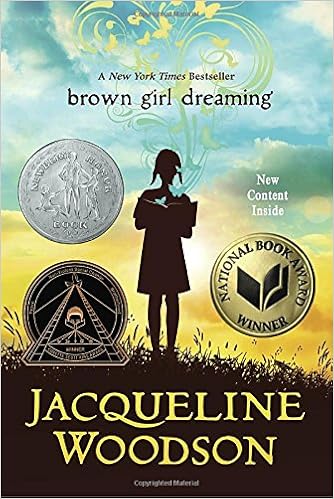
Brown Girl Dreaming


Woodson, J. (2014). Brown Girl Dreaming. New York, NY: Puffin Books.


This book reminds me a little of Crossover since it is written in free verse and autobiographical. It reminds me a little of How I Discovered Poetry since they are both accounts on growing up as black girls in America. Then there was also similarities to The Watsons Go to Birmingham. Both have black families that live in the north and are exposed to new culture when they travel to the south.Also the characters' mothers in both books are originally from the south but have been brought to the north through marriage to raise their families.

Jacqueline Woodson tells the story of being born in Ohio and moving to South Carolina while still very young.  She was raised by her grandparents pretty much while her mother went to New York to try to make a living. Her mother returns with a new baby in tow to bring Jacqueline and her siblings back to New York to live with her. Now they must readjust to living in a big city; much different than the country life they had in South Carolina. She writes of spending her summers down south and returning to New York. She shares stories of learning to read, having her hair pressed, going to church and understanding how African-American were expected to "act" when living in the south as opposed to living up north.  She meets a girl who will become a life long friend and becomes embraced by another family and their culture. She shares about living during the civil rights era as a young child. For her it was hearing about it from family members or on the news not really understanding what the fighting was about. Both because of age and perhaps because of location, New York, she was saved from some of the harsher realities of that time. If she had stayed in South Carolina with her grandparents her experiences would have been different.

I enjoyed this book so much.  It took me a long time to read it and I finally figured out it was because I kept reading the passages over and over again.  It must have been my subconscious not wanting me to stop reading it. This should be on a list for upper elementary or middle school grades. The structure of the story shows students that there is more than just one way to write. The way the tone changes from chapter to chapter and sometimes within a chapter shows students that writing is not one dimensional especially when you are writing about your life. I can see why this book is a National Book Award Winner. It is a wonderful piece. 

Tuesday, April 25, 2017

Bridge to Terabithia


Paterson, K. (1977). Bridge to Terabithia. New York, NY: Harper Trophy.

The benefits of friendship is the theme of this novel. Although it was written almost 40 years ago, it's message is still important today. Jess feels unappreciated maybe even unwanted at home. Being the only boy in a house full of girls, it is easy to see how he can feel and even get overlooked. He meets a new friend in Leslie Burke, the new girl at school. They become best friends and create a world for themselves and name it Terabithia. Leslie is pretty much everything Jess is not: rich, a girl, and confident. But as their friendship grows, Leslie encourages growth and confidence in Jess particularly when it comes to his talent in art. Both characters rub off on each other and help those around them like Jess's little sister and the school bully. Unfortunately, Leslie dies in an accident ironically as a result of her fearlessness. Jess comes to term with the loss and finds a new purpose for their "magic" kingdom. He "offers" it to his sister so that she can enjoy it like he and Leslie did.

This is a timeless novel perfect for elementary students age 9-11. Teachers could use it for a read aloud or novel study. The novel has evidence of various types of character conflicts: man vs man, man vs self, even man vs society.  I really like the character Jess.  He is a sensitive young boy that is going through some serious issues but he doesn't act out. This novel shows that you don't have to follow the path that others say you should just because you are a boy or a girl. Just be true to yourself.

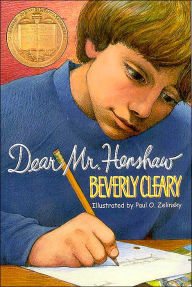
Dear Mr. Henshaw


Cleary, B. (1983). Dear Mr. Henshaw. New York, NY: Harper Trophy

Leigh Botts is a student assigned to write a letter to an author. He choose Mr. Henshaw because he likes his book Ways to Amuse a Dog. He thinks this will be a short assignment not thinking that Mr. Henshaw will write back or will write anything worthwhile. Unfortunately the author answers Leigh's letter with a series of questions. And Leigh's mother makes him answer them much to the boy's frustration. This begins a mentor relationship that Leigh really needs.  The reader soon discovers that Leigh has a tenuous relationship with his father, is dealing with his parents' divorce, and is struggling fitting in to a new school. Henshaw encourages Leigh to start a diary. This helps the boy get his feelings out. Once he begins to express himself, he begins to find ways to solve his problems. 

This novel is a good choice for boys who think they have to be tough and not express their feelings. It is good for all young students to see that others are dealing with family problems like divorce or feeling abandoned. It lets them know they are not alone. There isn't an exciting climax but it is a nice story showing a young boy growing up and maturing. 

Tuesday, April 11, 2017

The Watsons Go to Birmingham


Curtis, C ( 1995). The Watsons Go To Birmingham -1963. New York, NY: Yearling.

The United States was a different place in 1963. The southern states still practiced systematic discrimination of people of color. This novel addresses a family raising children during this time. The Watson family consists of a father, mother, their two sons Byron and Kenny and their daughter Joetta. The live in Detroit far away from the hatred in the south. The mom is from Birmingham and still has family there mainly her mother.  In the summer of 1963, the family takes a trip down to Birmingham. The kids experience what southern living is like complete with southern dialects, swimming in lakes, magnolia trees, and the extreme heat.  The trip brings a change in everybody. Byron, who normally is a troublemaker in Detroit, become more respectful and responsible. The mom who usually is the head of the household becomes a daughter again when around Grandma Sands. And Kenny who is usually very dependable begins to get careless and a bit reckless.

A near death experience for two characters change the family forever. The kids experience the ugly side of America and have to decide how to deal with it. The parents have to come to terms with the fact that their children came so close to something they have worked so hard to keep them from. But they realize their family is a lot stronger together than they ever could be if they are separated. They come to understand that they can depend on each other.

This is a fiction story written as a personal narrative. I thought it was an actual biography or memoir. Christopher Curtis includes a real historical event to bring a feeling of reality to the readers.The recollection of this and the response of the characters brings a sense of familiarity to readers who were alive during that time. He uses vivid imagery and quick witted dialogue to bring the setting and characters to life. Teachers can use this novel  to show how to writers use powerful vocabulary in their writing. It can also be included to show how a personal narrative is written 

Sunday, April 2, 2017

Crossover


Alexander, K. (2014). Crossover. New York, NY: Houghton Mifflin Harcourt.

Josh and Jordan (JB) Bell are twin brothers, the sons of former Professional European basketball player Charles (Chuck) "Da Man" Bell. They are preteens who have done pretty much everything together and are all the sudden growing apart. While they both love basketball, other things start to become just as important as it does with most boys. Other things like girls, love, crushes, and jealousy. Another theme throughout the book  is trust. Without giving too much away the narrator and his father both must deal with some trust issues to be able to heal fractures that are starting in the family unit.

The story is written in free verse prose. Kwame Alexander uses the voice of a preteen African American boy to produce a wonder story on family love and growing up.  You do not have to love basketball to appreciate this book and be moved to tears.

Friday, March 3, 2017

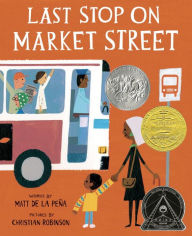
Last Stop On Market Street


De la Pena, M. (2015). Last Stop on Market Street. New York, NY: GP Putman Sons.

CJ is not too excited about having to go with his nana. He questions her on everything. Why do they have ride a bus? Why do they have to wait in the rain? Why? Why? His nana has a way of making the simplest of explanations sound wonderful and does a great job of making CJ and the reader appreciate all that is around them. Things like the sounds in nature, trees in the rain and a bus that breathes fire. The reader finds out the characters are going to a soup kitchen or homeless shelter to volunteer. Showing the family may not have a lot. They don't have a car, or can buy expensive mobile music players but they still can help others. 

I love this book for so many reasons. The message of charity for others is so important for young children. Not only is a great book to show how to appreciate your surroundings and look for the good things in every situation, but it is also full of great writing. When and author can write a kid's picture book with awesome writing and the young children can still understand, it is a must have.  I have used this book to teach about similes, descriptive language, strong verbiage, and complex sentences. We have used it to discuss different perspectives. Even though there are only 2 main characters, there are plenty of others that the readers sees in the pages as they read. The characters are so diverse; black, white, young, old, handicapped, different socio economic, and more.  You are presented with all of these variety without it being preached to you.  Everyone is just part of the book just like they would be part of the community. They just exist.