Showing posts with label disability. Show all posts

Friday, April 28, 2017

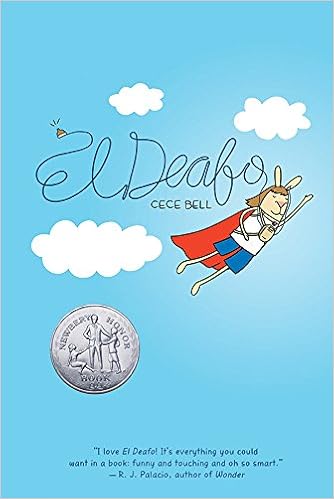
El Deafo


Bell, C. (2014). El Deafo. New York, NY: Amulet Books.

This is a autobiography written in a graphic novel format. Cece Bell was born healthy but as a young child she got meningitis and became deaf. She now must adjust to living in a hearing world. She goes to a school with other hear impaired students and learns how to lip read. By first grade she starts a new school in a new town. She attends a regular elementary and starts to wear the Phonic Ear. This device allows her to hear her teachers better and means she doesn't have to watch their lips.  Through the years, Cece makes friend and looses friends. She does her best to fit in without having her hearing impairment stand out. She is embarrassed by anyone who shows her special attention because of it especially when they attempt to use sign language. Cece refuses to learn it. She thinks it will make people stare at her.  Cece has the life of a typical young girl: slumber parties, first day of school jitters, and crushes. When her classmates realize her ability to hear her teacher no matter where she is located in the school because of the Phonic Ear, she becomes the class superhero. Cece realizes that her condition may not be a bad thing worth hiding from others after all.

This is another book that shows the power of living with a disability. These students just want to be included. They don't want any special treatment but come to realize that sometimes it is needed. This novel would be a good read for teachers and school counselors to include in lessons on acceptance and tolerance.

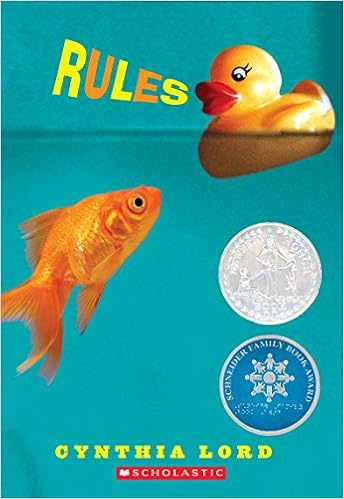
Rules


Lord, C. (2006). Rules. New York, NY: Scholastic Press.

Catherine is a babysitter not unlike other 12 year-olds. But her charge is her 8 year old autistic brother. She takes the role of watching him serious and has a series of rules to keep him in line and to help him function in public. Catherine the narrator in this book explains that every thing must be taught to her brother and he functions better when things are presented as rules. At David's occupational therapy sessions, Catherine strikes up a friendship with Jason. He is about her age maybe older and in a wheelchair. He uses word cards and a communication book to talk. Catherine draws pictures and Jason compliments her on one of her drawings. Their next visit she offers to create some word cards for him. 

At this time, there is a new family moving in across the street. Catherine is excited because the family includes a girl her age. She hopes they can become best friends. She is mortified at their first meeting because David has a breakdown. Eventually they strike up a friendship and Kristi seems to be sympathetic to Catherine's situation with her brother. 

Over the summer Catherine grows closer to Jason. Kristi wants Catherine to go to a dance with her and Ryan, a boy Catherine can't stand. When Catherine objects because she doesn't have a date, Kristi suggests Jason not knowing that Jason is non verbal and in a wheelchair.  Catherine is too embarrassed to tell Ryan and Kristi the truth so she makes excuses. Turns out the dance is the same day as Jason's birthday party and he invites her to that. So that becomes Catherine's excuse to not attend the dance. At the party, Jason finds out about the dance and asks Catherine to go with him. When she declines, he accuses her of being embarrassed of him.She denies it but he know its true. Catherine leaves the party with David and after some soul searching calls Jason's house and invites him to the dance.

Once there she introduces Kristi to David. Kristi is surprised to see Jason and Catherine apologizes for not be straightforward with her. Kristi leaves slightly upset. Catherine and Jason go and dance a big move for Catherine since she doesn't like to dance especially in public.

In the end Catherine learns to accept her brother warts and all and realize that their relationship is something special.

It must be hard to be a child and have so much responsibility put on you. And siblings of handicapped potentially have a lifetime of care giving ahead of them. When the parents get too old or pass it will be up the the siblings to take care of the person. Catherine is no different than any other 12 year old.She loves her brother but at times is embarrassed by his condition and just wishes for a reprieve every now and then. This is compounded when she meets and begins a relationship with Jason. Its the same feeling. She enjoys him but still is worried what others will think of the two of them if they are seen in public by people she knows. Students need to read this book. They need to understand that having a person that in your family that is different is nothing to be ashamed of. But it is understandable and common if you have feelings of exasperation at times. It is a growing process have an autistic person in your family and as much as Catherine tried, there isn't a rule book. 
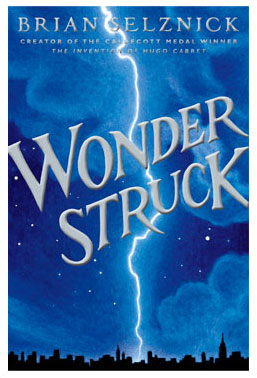
Wonder Struck


Selznick, B. (2011). Wonder Struck. New York, NY: Scholastic Press.

This novel is two separate stories that end up related. Ben Wilson is an orphan and lives with his aunt and uncle steps away from the house he used to share with his mother. He is deaf in one ear. He is searching around in his old house one day and finds the book Wonder Struck and a bookmark with a note. He assumes the note is from his father. While he is calling the bookstore that the bookmark is from, he is struck by lightning and become totally deaf. He is taken to a hospital but escapes to go find his father in New York.

The second story takes place fifty years earlier. Rose is deaf as well and is obsessed with actress who we later realize is her mother. She runs away to New York to be with her but is rejected. Feeling alone Rose runs to the American Museum of Natural History. Eventually she finds her brother Walter. He works there. He had written her a note on a postcard from there and that is how she finds him.

The museum is also where Ben runs to fifty years later. He meets a new friend Jamie but is still determined to find more information on his father. He goes to the the bookstore that was on the bookmark. Turns out Rose's brother Walter works there. Rose comes in and their stories collide. Ben and the reader discover that Rose is his grandmother and that his father has passed. The new found family members have found a place where they belong with each other. Ben has found a piece of his father. Rose has found a piece of her son.

Ben's story is told in text. Rose's is told in pictures. Brian Selznick has done this before.  I never read his other book The Invention of Hugo Cabret, but I did make my daughter, who hates reading, read it. She found the format enjoyable. I do too after reading this book. I think it would be appropriate for more advanced elementary readers. The story of wanting to belong somewhere and feeling alone is a common one in children around 10 years old. 

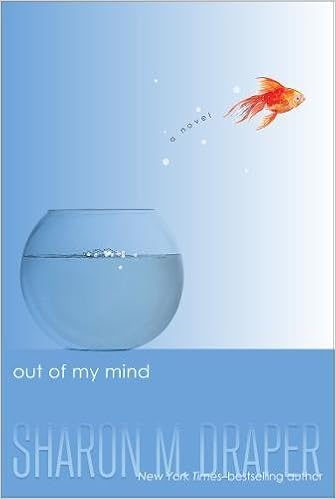
Out of My Mind


Draper,S. (2010). Out Of My Mind. New York, NY: Atheneum Books for Young Readers.

Melody is a fifth grader born with  Cerebral Palsy. She is non verbal but very bright as she absorbs all language around her. She hears it on TV, in songs, and in others around her.  She gets frustrated at her inability to warn others of dangers or tell others how silly they look talking to her as if she is a baby.  When she enters 5th grade, she begins the inclusion program at her school and gets to be around other normal abled students. She realizes how rude and unwelcoming her peers can be. It is during this year she gets a Medi-Talker. This machine allows her to communicate easier and show others how they were wrong in doubting her intelligence. She is presented with new opportunities one being qualifying to be a part of the school's trivia team. The team makes it to the finals which is a competition in Washington DC. But on the day of the trip, Melody's family is left behind. A suddent snowstorm causes their flight to be canceled and the rest of the team left earlier without even the courtesy of calling  the family.  This breaks Melody as she knew she was never really embraced by this group of kids. She is left behind literally. The next day Melody insists on going to school. Her mother is tired and its raining and get overwhelmed with preparing to leave while a rainstorm is raging. In all the chaos, Melody's mother accidentally hits her little sister Penny with the car as she backs out of the driveway. Penny survives with a broken leg and the Melody returns to school.The team apologizes for leaving her and offer their ninth place trophy as a piece offering. Melody laughs and breaks and tells them they deserve it.

This is a first person narrative account on what it is like to live with a disability. The highs and lows of wanting to be included buy realizing the limitations over and over again are very frustrating for Melody. Children should read this to gain some empathy for those that live everyday with a disability. It is more appropriate for upper elementary and middle school classrooms.  I like how the author included  Melody's perspective. It helps the reader feel as frustrated as she is. Her mind is very sharp its her body that is restrictive. Readers begin to feel like Melody. You want to do so much more than what you can. The tone in this book moves back and forth from frustration and elation. Students could come to find out that everybody has strengths, weaknesses, and faults. Some are just visible in different ways.  

Tuesday, April 25, 2017

The Nest


Oppel, K. (2016). Nest. New York, NY: Simon and Schuster Books for Young Readers

Reality and dreams are blurred in this suspenseful novel. Steve has a new baby brother. He was born with a serious disability. Around the same time, Steve starts to have dreams about an "angel". Steve's family discovers a wasp nest being built on the house. Soon Steve realizes it is not an angel visiting him in his dreams but the queen wasp. She informs him that she and the worker wasps are going to take his baby and leave a healthy perfect one for his family. Soon Steve realizes that taking his baby brother Theo is not a good idea and tries to stop the plan. However, the moths are determined and Steve's dreams, anxiety, and heroism collide in a thrilling ending.

I admit halfway through this book I wondered how is this considered a children's book. It seems very dark in nature. I thought it would turn out that Steve was bipolar and having a psychotic break. I  was very worried with how the novel would end.  As soon as I finished it my heart was still pounding. After thinking about it, I concluded that students with a taste for thrills might like this but I would caution any student who is very sensitive.