Showing posts with label biographies. Show all posts

Thursday, April 27, 2017

Balloons Over Broadway: The True Story of the Puppeteer of Macy's Parade


Sweet, M. (2011). Balloons Over Broadway: The True Story of the Puppeteer of Macy's Parade. New York, NY: Houghton Mifflin Books for Children.

A biography written about a man with an unusual but widely known job. The books explains how Tony Sarg became a puppeteer and created one of our most treasured holiday traditions.  When you look at the Macy's Thanksgiving Parade today it is hard to imagine that it started in the mind of one person.  He had and idea and had the gumption to put the idea into action.  Tony grew up creating and moved to London where he began to make puppets. After moving to New York City, he was approached by the owners of Macy's department store and asked to design a window display for the holidays. This turned in to coordinating a parade and eventually a parade of giant balloons. The balloons were made to make it easier for all to see no mater where they sat in the crowd.

This is pleasing biography to read to students during a study on inventors or biographies.The pictures were drawn by author Melissa Sweet. They pages are filled from edge to edge with pictures. There is no wasted white space. This also makes it easy for students to see the pictures no matter where they are sitting in your class. In addition to drawing there are pages with cutouts and photographs of real puppets. The pages are put together like a collage.  The story is also good to show that perseverance an admirable trait.

Wednesday, April 26, 2017

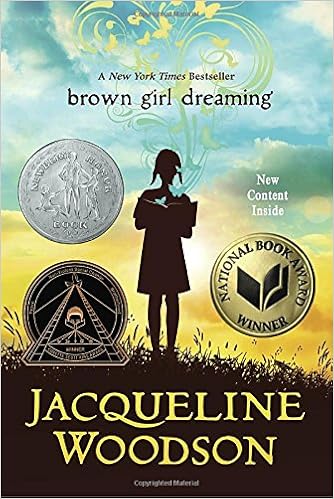
Brown Girl Dreaming


Woodson, J. (2014). Brown Girl Dreaming. New York, NY: Puffin Books.


This book reminds me a little of Crossover since it is written in free verse and autobiographical. It reminds me a little of How I Discovered Poetry since they are both accounts on growing up as black girls in America. Then there was also similarities to The Watsons Go to Birmingham. Both have black families that live in the north and are exposed to new culture when they travel to the south.Also the characters' mothers in both books are originally from the south but have been brought to the north through marriage to raise their families.

Jacqueline Woodson tells the story of being born in Ohio and moving to South Carolina while still very young.  She was raised by her grandparents pretty much while her mother went to New York to try to make a living. Her mother returns with a new baby in tow to bring Jacqueline and her siblings back to New York to live with her. Now they must readjust to living in a big city; much different than the country life they had in South Carolina. She writes of spending her summers down south and returning to New York. She shares stories of learning to read, having her hair pressed, going to church and understanding how African-American were expected to "act" when living in the south as opposed to living up north.  She meets a girl who will become a life long friend and becomes embraced by another family and their culture. She shares about living during the civil rights era as a young child. For her it was hearing about it from family members or on the news not really understanding what the fighting was about. Both because of age and perhaps because of location, New York, she was saved from some of the harsher realities of that time. If she had stayed in South Carolina with her grandparents her experiences would have been different.

I enjoyed this book so much.  It took me a long time to read it and I finally figured out it was because I kept reading the passages over and over again.  It must have been my subconscious not wanting me to stop reading it. This should be on a list for upper elementary or middle school grades. The structure of the story shows students that there is more than just one way to write. The way the tone changes from chapter to chapter and sometimes within a chapter shows students that writing is not one dimensional especially when you are writing about your life. I can see why this book is a National Book Award Winner. It is a wonderful piece. 

Friday, March 10, 2017

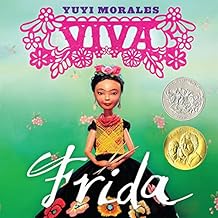
Viva Frida


Morales, Y. (2014). Viva Frida. New York, NY: Roaring Book Press.

There are a tremendous amount of books written about Frida Kahlo. It seems that ever since publishers realized that biographies were a hot genre for elementary readers, she became a popular subject. She had a very interesting life. This book illustrates what kind of person Frida was more than it shares information about her life. Readers see that she was a smart, caring person, who observed the world around her.  It is written in very simple two or three word sentences for example " I search" or "I play". However it is the photographs that really tell Frida's story. The illustrations are a mixture of photographs of dolls and drawings. Through the illustrations we see Frida had a husband, cared for animals, and was an artist.

The words do not tell much about Frida but it is a beautiful book. Reading this out loud would be an interesting way to introduce Frida or to begin a class discussion on her life if you have already studied her. 

Thursday, March 9, 2017

Harvesting Hope


Krull, K (2003). Harvesting Hope: The Story of Cesar Chavez. New York, NY: Harcourt, Inc.

This is a biography on the life of Cesar Chavez. The author writes about Cesar's life from a young boy to the farm workers' march he led in California. Cesar and his family were doing rather well in Arizona, Then due to a drought they lost their farm and home. They were forced to move to California to look for work. As he got older, Cesar helped organize farm workers to ask for higher wages, shorter hours, and better working conditions. He helped to create the National Farm Workers Association. They gathered workers and organized a march from Delano to Sacramento. The march wasn't easy. It damaging to their bodies and not everyone agreed with what they were doing. By the time they reached Sacramento, word had spread about their working conditions. More people supported their cause. Cesar was able to negotiate with the farm owners and get  higher wages and better conditions for the workers.

I use this book every year when my class studies biographies. It won an illustrator honor award but the story is written well too. I believe students in 3rd grade or higher could read the story independently and gather a lot from it. 

Friday, February 10, 2017

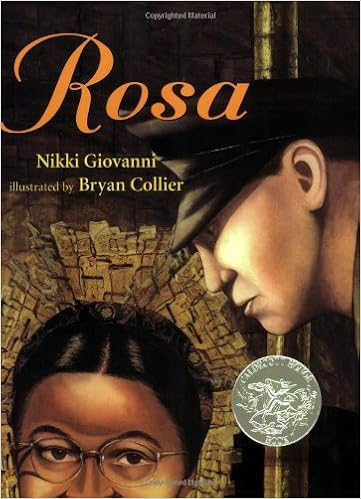
Rosa


Giovanni, N. (2005). Rosa. New York, NY: Henry Holt.

Rosa is an historical account of the day that Rosa Parks was arrested. Many student read a short blurb about her refusing to give up her seat to a white man but this gives more to her story. It may be fictionalized but it does explain her motivations as well as the motivations of others that lead the civil rights movement.

Rosa was a seamstress who was on her way home to cook dinner for her husband. She was sitting in a seat she had every right to sit in. She was arrested for standing up for what she felt was unjust. This book shows how such a simple gesture had a ripple effect on the city, state, and country.

Teachers could use this book for the obvious black history connection. As a civics lesson, teachers can show that just because something is a law doesn't make it right. It also is a good mentor text to show personal narratives. Every body has a story on a event from their life. Students do not need to write their whole life story to have something interesting to share.

I also think it is interesting that Nikki Giovanni left the actual arrest out of the story. She doesn't need to include it since her audience knows what happens and how Rosa's story ends. It is an interesting way to introduce to young student writers to not spend so much time on what the reader already knows.  Get to the point of the story.

This was a Illustrator Award Winner. Each picture takes about 3/4 of the two page spread. The text runs down the left or right side of the edge. This allows the pictures to be the focus if the book is used as a read aloud. The colors are not bright. They are rather muted with a lot of mustard and earth tones. The subject matter isn't a happy point in the Untied States' history so maybe that is why bright colors were not used.

Towards the end, two pages fold out to extend the size of the book. The content of these pages is the the nonviolent protest of bus boycott. The pages stretch to show how long the walkers stretched through the city.

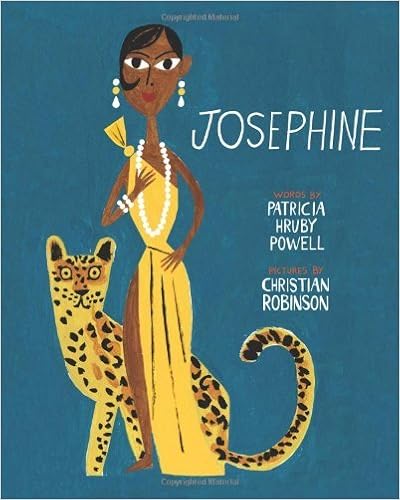
Josephine The Dazzling Life of Josephine Baker


Hruby Powell, P. (2014) Josephine The Dazzling Life of Josephine Baker. San Francisco, CA Chronicle Books.

This books takes readers through the life of the star Josephine Baker. I will admit I am a little bias with this subject I even named by dog after her. The book starts with her being born poor in St. Louis and moves on to her fame in Europe. She helped her mother wash clothes but was fascinated with the black vaudeville shows. She became part of the act when she joined The Jones Family and then at thirteen became a part of The Dixie Steppers touring with them. She was relegated to being their dresser. They traveled across the racial divided south and Josephine got to see segregation and experience in by performing not being able to visit white only theaters. After The Dixie Steppers stopped touring, she went to New York to be part of the first all-black show on Broadway. However she did get picked to be part of the show. She ended up being a dresser again. Josephine still learned all the dances and waited for an opportunity. When a dancer didn't show up she filled in and stole the show. She went on to dance in other shows but still was upset at the laws in the United States that wouldn't let her eat with white people and made her enter through back doors. Eventually she was invited to go to Paris and be part of La Revue Negre. Josephine found success in Europe charming everyone. She fame brought wealth. She still could not get respect in America. During World War II Josephine helped by joining the Parisian Red Cross and eventually became a spy to help defeat the Nazis. She performed for US soldiers and demanded that the black troops be allowed to sit in the front with the white troops. She married three times and during her third marriage she adopted twelve children from across the world. Showing how strong of a believer she was in in loving all. Raising the large family and extravagant spending led to her becoming broke. Josephine had to begin to tour again. This time she was welcomed in America. She still loss her house and had to depend on the the kindness of some of her friends to help her and her family. She ended up dying after celebrating a return to the Paris stage.

Josephine Baker was born in St. Louis poor and not expected to rise to much. This story is illustrates how her determined nature was the catalyst to her to overcome racism. The book includes direct quotes along with text written in verse. This biography is an easy read aloud for primary grades to understand and it's written in a manner that will keep their attention. I like the change in font between the author's verse and the direct quote. Putting Josephine's words in cursive seems appropriate since she was such a elegant figure. Like all Coretta Scott King Award winners and honorees this is a worthy book to include in a library that strives to be inclusive.

The book was an Illustrator Honor book.  The pictures are rather simple and "elementary" in nature. But it would appeal to younger students. There isn't a lot of other details added to each page.  And if Josephine is the focus of the text then she is the main picture also.  I like this style of drawings. They are sophisticated but still a little goofy just like the real Josephine Baker.