Showing posts with label pillars of character. Show all posts

Friday, April 28, 2017

George


Gino, A. (2015). George. New York, NY: Scholastic Press.


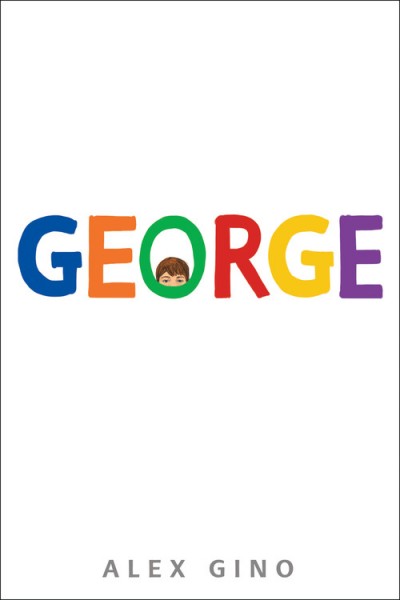
George is the title character in this novel that explores what it is like to be a transgender youth. George is a fourth grade girl who is struggling to come to terms with what makes her different than others in her class. They see a boy but inside she knows she is a girl.  Her mother doesn't understand and can't bring herself to accept it. She is bullied by boys in her class who see her as weak. Her ally is her best friend Kelly. Kelly is the first to accept that George is a girl. George's class is putting on a play Charlotte's Web. George would like nothing more than to be Charlotte. Her teacher Ms Udell says the role is only for a girl actor breaking George's heart. Luckily her friend Kelly, who won the part, is not insistent on playing the role. They devise a plan to split the responsibility and have George's wish fulfilled. The last chapter is one of the happiest things I have read in a long time. Seeing George getting to dress as girl and put on make up and be a girl in public even for a day trip to the zoo really brought home how much pain the transgender are in having to deny their true feelings.

This novel is appropriate for middle school age because of the subject manner. But as our society become more tolerant, hopefully it wont be such a controversial topic to bring up gender issues in elementary schools. George and Kelly are delightful and I appreciate how Gino shows different sides of the issues. Not every parent is ready to accept a change in their child and it does take some of them some time to get used to and accept the idea that their child is not who they thought they were. I liked how the topic of wanting to be a girl is brought up in something as simple as wanting to play a female part in a school's play. Because George is the protagonist and we as readers see her thoughts and feelings, we get a better understanding of what it is like for young people just realizing they are different from their peers. 

Friday, March 3, 2017

What Do You Do with a Problem?


Yamada, K. (2016). What Do You Do With a Problem? Seattle, WA: Compendium Inc.

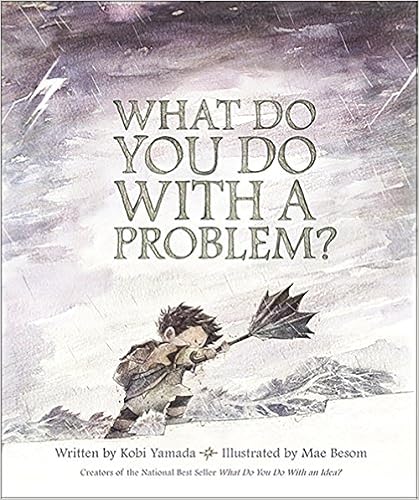
This book explains to young readers how to solve a problem. The unique thing is, the problem is represented as a gray cloud. It follows the narrator through out the book. The readers see that worrying, hiding, and ignoring it do not make the cloud go away. Finally the young boy tackles the the cloud and opportunity comes out of it.  

As adults we understand and appreciate the author's message. It is an important message for young readers to hear. They shouldn't run from problems as they will just follow you and get bigger. However if you are 3 or 4  years old you may think of this book in the literal sense. Gray clouds will follow you until you tackle it and make it stop. This is a good book to read out loud to discuss problem solving for young classes.  You could also use it with older students to show personification and lead a lesson on how to write and give non human things human characteristics. 

Friday, February 10, 2017

The Invisible Hunters/Los Cazadores Invisibles


Rohmer, H., Chow, O., Viduare, M. (1988). The Invisible Hunters/Los Cthwesazadores Invisibles (Stories from South America). New York, NY: Children's Book Press

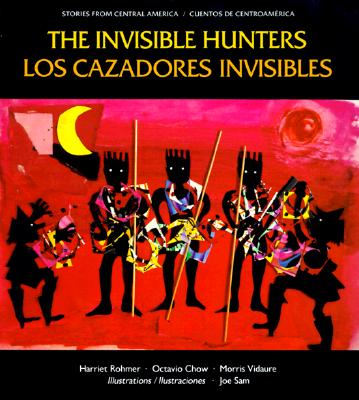
This book was a honored due to the illustrations. The artwork is bold and reminds me of art that would be found in a museum. After looking at it longer, I think the illustrations remind me of cave drawings.  The pictures don't include detailed faces. Just dark silhouettes going through motions.

The story focuses on a group of hunters in Nicaragua. They are looking for wild pig to hunt. They run into a magical vine that they discover can make them invisible if they are holding it. The hunters realize they can use this to their advantage while hunting. The vine said they may use pieces from it to help hunt as long as they promise not to sell the meat and only use sticks to hunt not guns. They promise. Their hunt goes well and the people of the village are fed well. They come to understand the power of keeping their promises to help others prosper.

Then the Europeans come and influence the hunters to sell them the meat. Soon their greed at getting meat for the Europeans gets the better of them and they forget what they promised the vine and begin to hunt with guns to get more meat quickly. The meat supply runs scarce and there isn't enough to feed the village. The hunters turn ugly to the villagers they use to help.  The hunters have forgotten their promise to the Dar and have forgotten that there are more fortunate if they help others in their community rather than looking out for themselves. 

One day they return from a hunt and the villagers turn from them. The elders tell them they are invisible even though they are no longer holding on to the vine. They return to the vine and ask for help but get none. Now they are invisible and are kicked out by the village as the elders tell them they are no longer welcome. They now are said to roam up the river begging to be visible again.

Other than the obvious message on how it is not good to be self serving, this story also explains the negative influence the Europeans had on native or indigenous people. The natives had survived for many years by living in a community that relied on different people to do different roles. When people do not do their roles the community does not survive. The Europeans coming in and changing the religion, beliefs, and rituals of the people in these groups caused them to weaken. When Europeans came in and invaded those groups already weak could not survive. 

Teachers could use this to teach citizenship lessons as well as show history. It makes it real simple to see how a change in people can affect others. This book is also bilingual. It would be nice in a school or classroom library at a dual language, ESL, or bilingual school. 

Each Kindness


Woodson, J. (2012). Each Kindness. New York, NY: Nancy Paulsen Books.

There is a new girl in Chole's class. She has older worn clothes. Chloe and her friends act rudely towards here not inviting her to play with them and ignoring her attempts at initiating a friendship. Pretty soon the new girl Maya just plays by herself. Then one day she doesn't show up to school. Chloe's teacher teaches a lesson on kindness and Chloe realizes she has been less then nice to the new student. She waits to make it up to Maya but she never returns and the teacher later informs them that Maya's family has moved. Chloe realizes she will never get a chance to make it up to Maya.

This book is told from the  first person point of view. Young readers will be able to identify with the narrator having regrets about her behavior. Most children have done something to someone that they wish they could take back. Some young people may identify with the other character Maya because they were once a new person in a class. Even though we don't get to see Maya's thoughts we can sympathize with someone being rejected by others. This would be a good book to read aloud during Kindness week at elementary schools. Counselors could find it useful when teaching lessons on how to make friends or how to be a good friend.

This was an Coretta Scott King Author Honor book. Ms Woodson tells a important story in a way that children can understand. The pictures are pretty also. The cover shows a girl standing by herself. She looks alone and sad. The readers can tell this won't be a happy story. Using the title and cover, teachers can have a good discussion on predictions. "Why is the girl alone? What does it mean by Each Kindness? Was someone unkind to the girl on the cover?" Some illustrations are a two page spread but there isn't a lot going on in the picture. I think this helps narrow the readers focus on the subject. For instance on the page where Maya is jump roping, she is the only thing on the two pages. This exemplifies that she was really alone. No one was playing with her. The last page as well has one character in a scene spread over a double page spread. Chloe is small compared to the whole scene of the pond and trees around her. This helps the reader understand how lonely she feels while remembers how unkind she treated Maya. I thinks it shows her in a state of self reflection and that she is not happy with herself. 

Saturday, February 4, 2017

Why Mosquitoes Buzz in People's Ears


Aardema, V. (1975). Why Mosquitoes Buzz in People's Ear. New York, NY: Dial Books.

In this African folktale Verna Aardema, takes readers through a forest to see a giant chain of events. It all starts with an iguana getting bugged by a mosquito. He doesn't want to hear the insect talk anymore so he puts sticks in his ears. Then a python tries to speak to the iguana, but since he can't hear, he keeps walking. The python becomes fearful thinking the iguana is mad at him and is trying to hurt him. He slithers into a rabbit hole to hide. The rabbit seeing this gets scared and runs off. A crow sees the rabbit running and sends out a warning call to the other animals in the forest. A monkey hears this call and assumes a beast is coming to attack the animals. He bounds through the trees and inadvertently knocks an owlet out of the nest and it dies.

This upsets the mother owl so much, she refuses to do her job, waking the sun. So the forest stays under a night sky. The animals have a meeting to find out why the night is lasting so long. King Lion asks the Mother Owl. She says she is too upset to wake the sun because the monkey killed one of her babies. The animals proceed to unravel the story and end up at realizing this is all the mosquito's fault. They decide to punish the bug. He hears this and goes into hiding. He goes around and whining in people's ears asking if the other animals are still mad at him. Thus the reason why mosquitoes are always buzzing around people.

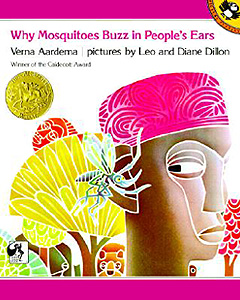
As all folktales do, this one explains an occurrence in nature. The illustrations are bright and not the typical drawings. Children do like this story. I have read it every year when we study traditional literature. The onomatopoeia in the story is a unique way to show "animal speak". Teachers could use this as a lesson to show why it is always important to not lie or how one lie can cause a series of bigger problems.  I like to use it to show sequence and cause and effect in literature. 

Monday, January 30, 2017

Sam, Bangs, & Moonshine


Ness, E. (1966). Sam, Bangs, & Moonshine. New York, NY: Henry Holt and Company.

This is a story about a girl with a problem with lying. Samantha (Sam for short) lives in a fishing town with her father  a fisherman and her cat Bangs. She has told stories or fibs to all the people in the town. However there is  young boy who believes her stories and one day goes out on a quest based on one of her lies. It ends up putting him and Sam's cat in grave danger. 

This would be a good story for parents to share with young children about possible repercussions that could result from lying.  Even though I felt Sam wasn't lying so much as she just was a child with a vivid imagination, the story does teach a good lesson for children that there comes a time when they must start telling the truth.

The word choice would make this a great mentor text to teach students how to use vivid words to describe a scene. Phrases like " menacing rumble of thunder" and "grey ribbed curtain of rain" paint the picture of a terrible storm taking place. 

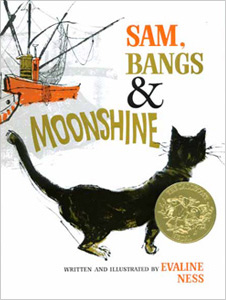
The art work is unique being that only three colors are used; gold, black, and gray. They are complimentary and don't take away from the story that is taking place.