Showing posts with label poetry. Show all posts

Wednesday, September 20, 2017

Poetry

Poetry doesn't have to rhyme. There are no rules for poetry. It is meant to be read and reread. It is a form of writing that gives students freedom.

Poems allow reader to share emotions, experiences, and visions with the poet.

Poetry brings a new understanding of the world.
Poems should include characters, situations, and locations that students are familiar with.
Poetry

  1. bring enjoyment
  2. shares a knowledge of a concept
  3. increases vocabulary
  4. helps children identify with people and situations
  5. helps students understand feels
  6. grants insights on the feelings of others
7th -9th grade students prefer rhyme, humor, narrative poems that are on a familiar experience just like elementary students. 

The Elements of Poetry are:
  • rhytm
  • rhyme
  • alliteration
  • assonance
  • anomatopoia
  • repetition
  • imagery
  • shape
Forms of poetry are:
  • lyrical
  • narrative
  • ballads
  • limericks
  • concrete
  • haiku

Poetry dissection as classroom lesson is boring and an unnecessary. Students should instead be taught how to read poetry. They should be shown different ways to experience it.

  • moving to poety
  • chorale reading
  • dramatizing poetry
  • saying the refrain
  • line arrangement
  • recognizing dialogue and antiphonal
  • read in unison 
Types of poetry
  • Nonsense- funny, fun, no real meaning
  • Humorous- funny but realistic
  • Nature- poets try to give respect and reverence for nature by showing its beauty
How I will read and evaluate poety

I will see if the subject of the poem is something students are familiar with. Will the form or structure help them understand the meaning especially for those who are new to poetry. Is the imagery something young adults can understand. Just like fiction and nonfiction literate., poetry should reflect the changes that young adults experience and see around them

Tuesday, April 11, 2017

Mirror Mirror


Singer, M. (2010). Mirror Mirror: A Book of Reversible Verse. New York, NY: Dutton Children's Books.

Rewriting popular fairy tales into poems is a feat. Rewriting them into poems that can be read in reverse is even harder. This book is a collection of verses covering tales like the Princess and the Frog, Cinderella, The Ugly Duckling, and others.  The poems are written two ways. For some poems, the meaning is changed when they are flipped. The illustrations also change depending on which poem you read. For example in "Have Another Chocolate", the poem is written from the perspective of the witch in Hansel and Gretel. When read in reverse, the perspective changes to someone trying to help Hansel trick the witch.

This would be a good book to use in teaching point of view to students. It would also be a fun addition to read during a poetry or fairy tale unit. 

Friday, March 10, 2017

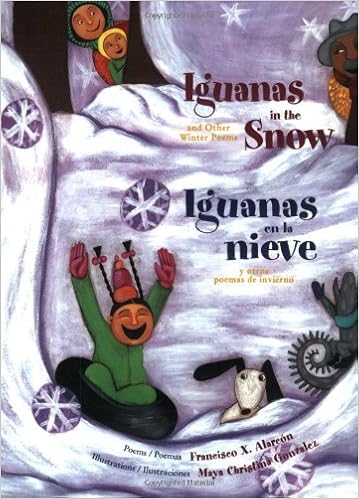
Iguanas in the Snow and Other Winter Poems


Alacórn, F. (2001). Iguanas in the Snow:And Other Winter Poems. New York, NY: Lee & Low Books.

Iguanas in the Snow and Other Winter Poems is a collection of poems set in the San Francisco Bay Area.  Poet Francisco Alarcón presents the poems in both English and Spanish offering readers a chance to experience the musicality of both languages.  Maya Gonzalez’ illustrations are colorful and playful.  In the afterword, parents will appreciate Alarcón’s explanation of where he got inspiration for his poetry.   

Friday, February 10, 2017

How I discovered Poetry


Nelson, M. (2014). How I Discovered Poetry. New York, NY: Dial Books.

This is a collection of poems written as a narrative of the author's or poet's life as a young girl in the 1950s trying to find a place to fit in; trying to find her purpose in life. At first, I thought they were all true but in her note at the end she says some of the poems are fictionalized but still based on her life experiences none the less. They read like a young girl going through military moves and daydreaming about life possibilities. They also read like a young black girl going through what life is life for an educated young a black girl; too black for white kids not black enough for the black kids. She doesn't miss anything in her memories of growing up black. It is hard being the only black student or child surrounded my white children. Almost every black child has been asked to have their hair touched.  Dealing with uninformed children and "well meaning" teachers is a hard task and it stays with young African-Americans; proof shown in that Nelson was still affected by it enough to write about it as an adult.

This was an Author Honor book. It is beautifully written. I wouldn't include it in a primary library, but I would in a middle and or high school library.  Teachers of fourth and fifth graders could read some of the poems to show examples of narrative poetry or poems written from the first person point of view.