Friday, April 28, 2017


Klassen, J. (2012). This is not My Hat. Somerville, MA: Candlewick Press.

A tiny fish has stolen a hat from a much bigger fish and thinks he has gotten away with it. He is swimming to hide in some tall sea grass.  A crab rats him out to the big fish. The small fish's hiding place is found. The last page shows the big fish with the hat on his head. Leading the reader to assume that tiny fish has met his maker.

Tiny kids love to read this book and the similar I Want My Hat Back. They are delighted to see the the final page and guess that the animal has been eaten by the bigger one. Jon Klassen has found a winning formula. The pictures are simple but appealing. they are set against a black background so the audience's attention is on the fish and nothing else. It is important to pay attention to the details like the larger fish's eyes. They are part of the story as well.

We Are the Ship: The Story of Negro League Baseball


Nelson, K. (2008). We Are the Ship:The Story of Negro League Baseball. New York, NY: Hyperion Books.

This is the story of the African American players of the Negro League. Before sports was integrated, before the country was fully integrated, there was a baseball league for colored players. This book tells their stories. Athletes like Wilber "Bullet" Rogan, Quincy Trouppe, Satchel Paige, and even Jackie Robinson had a home in this league before they were welcomed in the MLB. The narrator shares how the league was formed, what it was like to travel on the buses, how they were treated as heroes and disrespected. 

Back then players played because they loved the game. Their talent was cultivated anywhere else. Their fame was limited. They persevered through rough times to pave the way for future athletes to live their dreams.

This is written as if it were an autobiography. The narrator is an unknown observer. The first person account gives readers insight on how the player felt.  Teachers can use this book to bring up the ideas of fairness and injustice. It lets young readers know that our country wasn't always welcoming to everyone no matter if they were talented or not. 

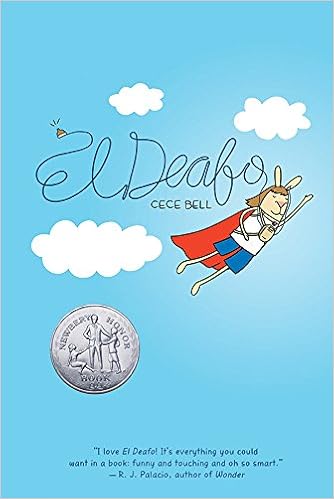
El Deafo


Bell, C. (2014). El Deafo. New York, NY: Amulet Books.

This is a autobiography written in a graphic novel format. Cece Bell was born healthy but as a young child she got meningitis and became deaf. She now must adjust to living in a hearing world. She goes to a school with other hear impaired students and learns how to lip read. By first grade she starts a new school in a new town. She attends a regular elementary and starts to wear the Phonic Ear. This device allows her to hear her teachers better and means she doesn't have to watch their lips.  Through the years, Cece makes friend and looses friends. She does her best to fit in without having her hearing impairment stand out. She is embarrassed by anyone who shows her special attention because of it especially when they attempt to use sign language. Cece refuses to learn it. She thinks it will make people stare at her.  Cece has the life of a typical young girl: slumber parties, first day of school jitters, and crushes. When her classmates realize her ability to hear her teacher no matter where she is located in the school because of the Phonic Ear, she becomes the class superhero. Cece realizes that her condition may not be a bad thing worth hiding from others after all.

This is another book that shows the power of living with a disability. These students just want to be included. They don't want any special treatment but come to realize that sometimes it is needed. This novel would be a good read for teachers and school counselors to include in lessons on acceptance and tolerance.

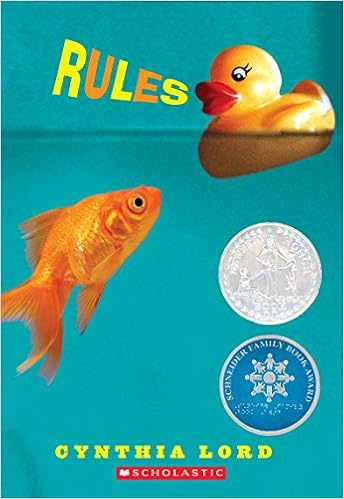
Rules


Lord, C. (2006). Rules. New York, NY: Scholastic Press.

Catherine is a babysitter not unlike other 12 year-olds. But her charge is her 8 year old autistic brother. She takes the role of watching him serious and has a series of rules to keep him in line and to help him function in public. Catherine the narrator in this book explains that every thing must be taught to her brother and he functions better when things are presented as rules. At David's occupational therapy sessions, Catherine strikes up a friendship with Jason. He is about her age maybe older and in a wheelchair. He uses word cards and a communication book to talk. Catherine draws pictures and Jason compliments her on one of her drawings. Their next visit she offers to create some word cards for him. 

At this time, there is a new family moving in across the street. Catherine is excited because the family includes a girl her age. She hopes they can become best friends. She is mortified at their first meeting because David has a breakdown. Eventually they strike up a friendship and Kristi seems to be sympathetic to Catherine's situation with her brother. 

Over the summer Catherine grows closer to Jason. Kristi wants Catherine to go to a dance with her and Ryan, a boy Catherine can't stand. When Catherine objects because she doesn't have a date, Kristi suggests Jason not knowing that Jason is non verbal and in a wheelchair.  Catherine is too embarrassed to tell Ryan and Kristi the truth so she makes excuses. Turns out the dance is the same day as Jason's birthday party and he invites her to that. So that becomes Catherine's excuse to not attend the dance. At the party, Jason finds out about the dance and asks Catherine to go with him. When she declines, he accuses her of being embarrassed of him.She denies it but he know its true. Catherine leaves the party with David and after some soul searching calls Jason's house and invites him to the dance.

Once there she introduces Kristi to David. Kristi is surprised to see Jason and Catherine apologizes for not be straightforward with her. Kristi leaves slightly upset. Catherine and Jason go and dance a big move for Catherine since she doesn't like to dance especially in public.

In the end Catherine learns to accept her brother warts and all and realize that their relationship is something special.

It must be hard to be a child and have so much responsibility put on you. And siblings of handicapped potentially have a lifetime of care giving ahead of them. When the parents get too old or pass it will be up the the siblings to take care of the person. Catherine is no different than any other 12 year old.She loves her brother but at times is embarrassed by his condition and just wishes for a reprieve every now and then. This is compounded when she meets and begins a relationship with Jason. Its the same feeling. She enjoys him but still is worried what others will think of the two of them if they are seen in public by people she knows. Students need to read this book. They need to understand that having a person that in your family that is different is nothing to be ashamed of. But it is understandable and common if you have feelings of exasperation at times. It is a growing process have an autistic person in your family and as much as Catherine tried, there isn't a rule book. 

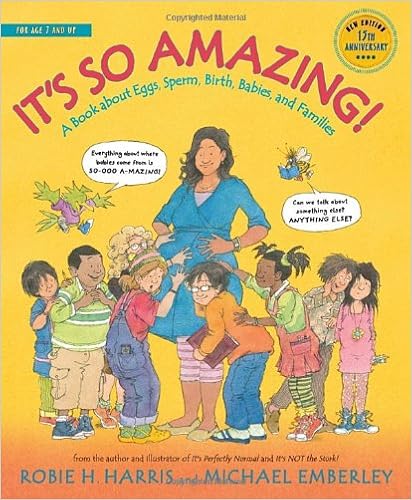
It's So Amazing: A book About Eggs, Sperm, Births, Babies, and Families


Harris, R. (1999). It's So Amazing: A Book About Eggs, Sperm, Births, Babies, and Families. Somerville, MA: Candlewick Press.

This is an encyclopedia on everything a parent would need to teach their child concerning sex. It includes diagrams and functions on all body parts. It talks about how puberty will effect your body. It goes into the scientific explanation of how babies are made: a sperm meets with an egg. It also talks about the physical act of making a baby: sex. Then the book shares different ways babies are born. The sex education continues in discussing different STDs. 

The author's purpose is to inform readers on all aspects of sex and our bodies.  I wouldn't include it in a school as not every parent is ready for their child to learn about every aspect of sex. I respect the fact that families can choose when to introduce various topics to their children. I would include it my home. It is a very good detailed resource and I think it could answer almost any question my children could ask.

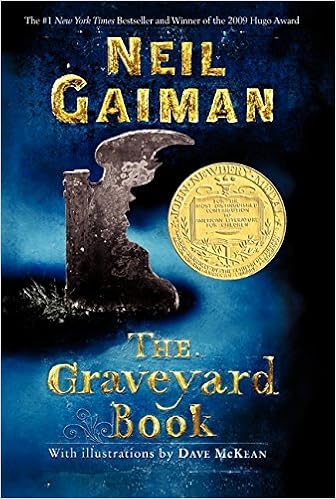
The Graveyard Book


Gaiman, N. (2008). The Graveyard Book. New York, NY: Harper Collins Publishers.

A family is murdered. That is how this story begins. The lone survivor, a baby, crawls to a graveyard. He is protected from the killer by the inhabitants and eventually adopted by them. He is granted free reign of the graveyard . This books has ghosts, werewolves, vampires, witches, and goblins. The young boy, Bod, short for Nobody, has various encounters with all of these as he learns to navigate in the world of the dead. He eventually convinces his caretaker Silas to let him attend venture out of the cemetery and attend school.But that doesn't end well. He uses his powers he has learned to defeat some school bullies but this brings unwanted attention.

Some time later, an old friend Scarlet returns. She was a childhood friend of Bod whose parents moved to Scotland for her father's teaching job. She has met a historian who now lives in the house that Bod's family was killed. Being that the man Mr. Frost is now a friend of the family, Scarlet asks him to do some research on the murders for her friend Bod. She invites Bod over to the house to meet Mr.Frost. Turns out it is Jack Frost the man who has been trying to kill the boy. There is a prophecy that Bod will destroy the the society that Jack belongs to, Jack of all Trades. 

Scarlet and Bod escape to the graveyard when Jack reveals his true intentions. The members of the Jack society chase them. Once in the graveyard, three of the Jack fall to their death. Bod somehow manages to trick Jack Frost into declaring himself the Sleer's master and the Sleer wraps him up and takes him goodness know where. Silas comes and erases Scarlet's memory of all the traumatic events.He then convinces Scarlet's mother to return to Scotland.

When the book ends, a 15 year old Bod is growing out of the ability to travel around the graveyard and do what he used to like seeing ghosts. Silas gives him some money and a passport and Bod leaves his old life behind.  

I did not enjoy this book. I am not a fan of vampires, witches,horror and ghost stories. This novel had all that. It was a hard read because the action was very slow in the beginning. The Old English language was hard to understand as well. I don't understand how a book dealing with someone trying to murder someone is thought of as children's literature. 

How They Croaked


Bragg, G (2011). How They Croaked: The Awful Ends of The Awfully Famous. New York, NY: Recorded Books, Inc.

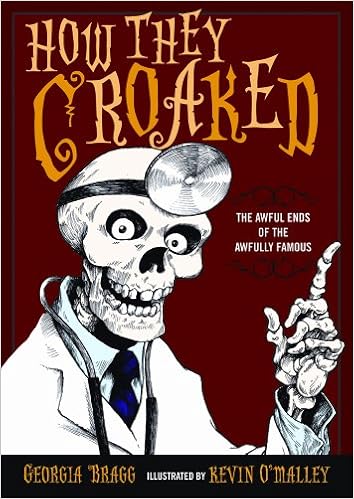
A nonfiction book about the deaths of famous people. It is very graphic in some parts. For example it tells how King Tut's insides were scooped out, and how Columbus had diarrhea while at sea. The famous people lucky enough to make this list include Charles Dickens, Marie Antoinette, Mozart, and Albert Einstein.  This is loosely nonfiction. It isn't written as a history book. The language and content is not formal at all. While all that is included may be true, it is presented more like stand up comedy. The chapter on Marie Curie is title "You Glow Girl" and Henry VIII's chapter is called "Who Not to Marry."

I don't think I would include this in elementary at all. I probably wouldn't include it in any school library because I don't know if I can trust if it is all factual. It is more Mad Libs than historical. 

Wonder Struck


Selznick, B. (2011). Wonder Struck. New York, NY: Scholastic Press.

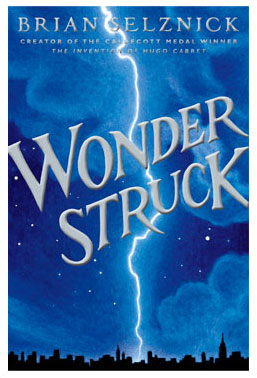
This novel is two separate stories that end up related. Ben Wilson is an orphan and lives with his aunt and uncle steps away from the house he used to share with his mother. He is deaf in one ear. He is searching around in his old house one day and finds the book Wonder Struck and a bookmark with a note. He assumes the note is from his father. While he is calling the bookstore that the bookmark is from, he is struck by lightning and become totally deaf. He is taken to a hospital but escapes to go find his father in New York.

The second story takes place fifty years earlier. Rose is deaf as well and is obsessed with actress who we later realize is her mother. She runs away to New York to be with her but is rejected. Feeling alone Rose runs to the American Museum of Natural History. Eventually she finds her brother Walter. He works there. He had written her a note on a postcard from there and that is how she finds him.

The museum is also where Ben runs to fifty years later. He meets a new friend Jamie but is still determined to find more information on his father. He goes to the the bookstore that was on the bookmark. Turns out Rose's brother Walter works there. Rose comes in and their stories collide. Ben and the reader discover that Rose is his grandmother and that his father has passed. The new found family members have found a place where they belong with each other. Ben has found a piece of his father. Rose has found a piece of her son.

Ben's story is told in text. Rose's is told in pictures. Brian Selznick has done this before.  I never read his other book The Invention of Hugo Cabret, but I did make my daughter, who hates reading, read it. She found the format enjoyable. I do too after reading this book. I think it would be appropriate for more advanced elementary readers. The story of wanting to belong somewhere and feeling alone is a common one in children around 10 years old. 

The Boy on the Porch


Creech, S. (2013). The Boy on the Porch. New York, NY: Harper Collins.

A young boy around 5 or 6 is left on the porch of couple. He doesn't talk and the note left with him asks the couple to take care of him and that they will return for him.  Marta and John are unsure what to do with him but end up not calling authorities. I think silently they are hopeful that the he will be theirs. They slowly grow into a family. Jacob the boy learns to communicate by tapping. He has a talent for music and art. They begin to treat him as their son and introduce him to others in town. Just as the begin to make arrangements to make their family legal, they get a visit from a stranger. It is Jacob's father. He has returned to take him. It is obvious to Marta and John and the readers that his man will not foster his talents like the couple did. They beg to let him stay but the father refuses. Jacob leaves with him taking a guitar and the farm is broken without him. Looking for him bring no positive results and their letters to him are returned. Eventually they become foster parents. It never fills the hole left by Jacob, but it helps.  One day their beagle who has been down and depressed since Jacob's departure begs to go outside. There sleep in a chair on their porch was a young man with a guitar.

A sweet story on what makes a family. This would bring tears to anyone who reads it. The theme is love and patience are all that most kids with troubled backgrounds need to flourish. I wouldn't hesitate to read this aloud to my class.

Soar


Bauer, J. (2016). Soar. New York, NY; Puffin Books

Jeremiah was left by his mother in an office building. Most kids would let that feeling of desertion control their lives.  Not Jeremiah. He is adopted by Walt he man who found him and ends up needing a heart transplant. But he has an determined spirit and won't slow down. They move to Hillcrest, Ohio where the whole town is obsessed with baseball. This is fine with Jeremiah and Walt since they both love the game.  There is a mystery as to why the middle school that Jeremiah attends doesn't have a team but the high school has a championship team. Soon after they arrival the star pitcher of the baseball team Hargie Cantwell dies. And team and coach are engulfed in a scandal involving steroids. The town begins to lose faith in the game they love. Jeremiah takes it upon himself to bring back the sport for the team. He can't play because of his heart but he can coach. His spirit and determination are plenty to bring back hope and to remind everyone that it  is not about winning at all costs but about love of the game.

This is a story about the repercussions of cheating and accepting people just as they are.  Finding joy gets losts in sports and even in education as parents and teachers sometimes push for perfection. This book is a reminder that should not be the goal. And you may have limits on your abilities but you can find a role for yourself in just about any situation. This was also one of three books I read about boys being abandoned by their parents. I thought it was going to take a different turn and delve into family matters but it didn't. Teachers in intermediate grades could add this to their classroom libraries. I would recommend it for students nine years and older.

The Legend of the Bluebonnet


DePaola, T. (1983). The Legend of the Bluebonnet. New York, NY: Penguin Young Readers Group.

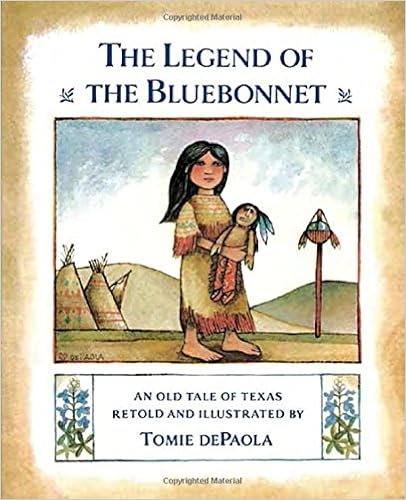
A tribe of Comanche are suffering through a devastating drought. She -Who-Is-Alone is member of this tribe. The shaman tells the tribe the Great Spirits say they have been selfish and taken from the land.They must make a burnt offering of their most prized possessions to pay the land back. No one is willing to part with their possessions. She-Who-Is-Alone burns her doll as an offering to the Great Spirits. It is the only thing she has left from her family who has died in the drought. The next morning the Native Americans wake up to a field of blue flowers. The same color blue as the feathers in the girl's doll. The Great Spirits send rain and the drought is over. The girl is than called One-Who-Dearly-Loved-Her-People.

As legends do, this story gives a fictional account on a natural occurrence. This tale explains why Texas is showered with bluebonnets every spring. In Texas school, it is a must read. Teachers use it as part of their study on legends or as and fun read during a Texas unit. The painting's colors are warm and true to the southwest art. they way characters dress and scenery are true to the Native American culture.  

Out of My Mind


Draper,S. (2010). Out Of My Mind. New York, NY: Atheneum Books for Young Readers.

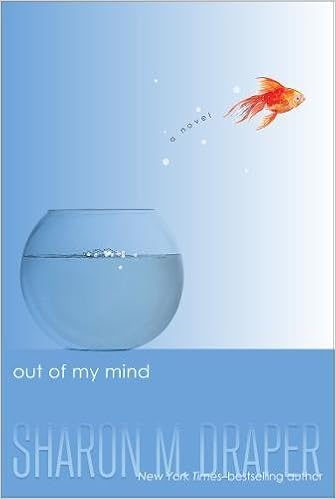
Melody is a fifth grader born with  Cerebral Palsy. She is non verbal but very bright as she absorbs all language around her. She hears it on TV, in songs, and in others around her.  She gets frustrated at her inability to warn others of dangers or tell others how silly they look talking to her as if she is a baby.  When she enters 5th grade, she begins the inclusion program at her school and gets to be around other normal abled students. She realizes how rude and unwelcoming her peers can be. It is during this year she gets a Medi-Talker. This machine allows her to communicate easier and show others how they were wrong in doubting her intelligence. She is presented with new opportunities one being qualifying to be a part of the school's trivia team. The team makes it to the finals which is a competition in Washington DC. But on the day of the trip, Melody's family is left behind. A suddent snowstorm causes their flight to be canceled and the rest of the team left earlier without even the courtesy of calling  the family.  This breaks Melody as she knew she was never really embraced by this group of kids. She is left behind literally. The next day Melody insists on going to school. Her mother is tired and its raining and get overwhelmed with preparing to leave while a rainstorm is raging. In all the chaos, Melody's mother accidentally hits her little sister Penny with the car as she backs out of the driveway. Penny survives with a broken leg and the Melody returns to school.The team apologizes for leaving her and offer their ninth place trophy as a piece offering. Melody laughs and breaks and tells them they deserve it.

This is a first person narrative account on what it is like to live with a disability. The highs and lows of wanting to be included buy realizing the limitations over and over again are very frustrating for Melody. Children should read this to gain some empathy for those that live everyday with a disability. It is more appropriate for upper elementary and middle school classrooms.  I like how the author included  Melody's perspective. It helps the reader feel as frustrated as she is. Her mind is very sharp its her body that is restrictive. Readers begin to feel like Melody. You want to do so much more than what you can. The tone in this book moves back and forth from frustration and elation. Students could come to find out that everybody has strengths, weaknesses, and faults. Some are just visible in different ways.  

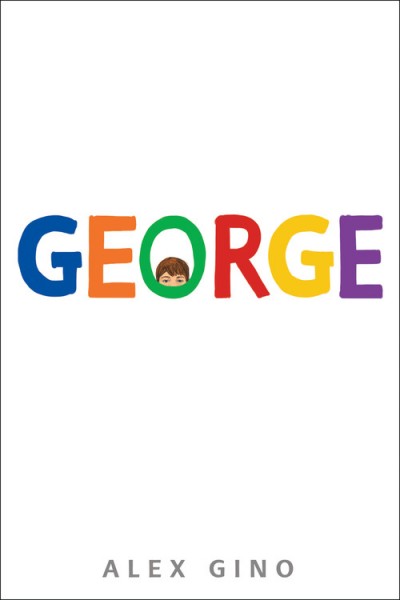
George


Gino, A. (2015). George. New York, NY: Scholastic Press.


George is the title character in this novel that explores what it is like to be a transgender youth. George is a fourth grade girl who is struggling to come to terms with what makes her different than others in her class. They see a boy but inside she knows she is a girl.  Her mother doesn't understand and can't bring herself to accept it. She is bullied by boys in her class who see her as weak. Her ally is her best friend Kelly. Kelly is the first to accept that George is a girl. George's class is putting on a play Charlotte's Web. George would like nothing more than to be Charlotte. Her teacher Ms Udell says the role is only for a girl actor breaking George's heart. Luckily her friend Kelly, who won the part, is not insistent on playing the role. They devise a plan to split the responsibility and have George's wish fulfilled. The last chapter is one of the happiest things I have read in a long time. Seeing George getting to dress as girl and put on make up and be a girl in public even for a day trip to the zoo really brought home how much pain the transgender are in having to deny their true feelings.

This novel is appropriate for middle school age because of the subject manner. But as our society become more tolerant, hopefully it wont be such a controversial topic to bring up gender issues in elementary schools. George and Kelly are delightful and I appreciate how Gino shows different sides of the issues. Not every parent is ready to accept a change in their child and it does take some of them some time to get used to and accept the idea that their child is not who they thought they were. I liked how the topic of wanting to be a girl is brought up in something as simple as wanting to play a female part in a school's play. Because George is the protagonist and we as readers see her thoughts and feelings, we get a better understanding of what it is like for young people just realizing they are different from their peers. 

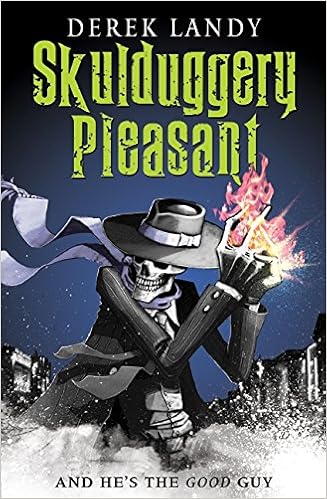
Skulduggery Pleasant


Landy. D (2007). Skulduggery Pleasant. New York, NY: Harper Collins.

It starts with a writer's death. Then the familiar reading of the will with the greedy brother and his wife, a friend of the deceased who is a stranger to all in the family, and a surprised, sweet, favored niece who gets the bulk of the estate. When Stephanie the a fore mentioned niece ends up having to stay the night in her new home alone, an intruder attacks her. In comes the stranger from the will reading, he is fighting with the intruder. Here is where the story turns. When throwing the man around doesn't stop him the stranger throws fire, yes fire at him. Even that doesn't work. So he shoots at him to scare him off. After the attacker leaves, Stephanie sees that her savior is a skeleton! Just like that the reader is introduced to the hero of this tale and what starts out as a realistic fiction centered around a family turns into high action fantasy fiction. Skulduggery Pleasant is the name of the hero. Stephanie finds out her uncle was murdered. She and Skulduggery go off in search of the murdered and the Sceptre of the Ancients. The form a team with others: Ghastly Bespoke and China Sorrows.They fight sorcerers, team up with other magical or elemental beings. They are double crossed but never deter. They must keep Serpine the evil sorcerer, and Uncle Gordon's murderer, from controlling the world with the Book of Names. Eventually they destroy him and decide to become a powerful duo fighting evil magic. Stephanie then changes her name to Valkyrie Cain.

There is a niche for boys' fiction. This book and the ones that are part of the Skulduggery Pleasant series would fall into that niche. Boys of middle school age would read and probably enjoy this even if they do not love to read.  Girls can find this enjoyable too. The protagonist is a tough 12 year old female who doesn't just let all the males do the heavy action. I was surprised that I liked this book.  I may not continue the series but would recommend it to students who need to graduate from Big Nate and the like. 

Martina the Beautiful Cockroach: A Cuban Folktale


Deedy, C. (2007). Martina The Beautiful Cockroach: A Cuban Folktale. Atlanta,GA: Peachtree Publishers. 

In a world where cockroaches are considered beautiful, a story is shared about finding a soulmate who is truly kind inside and out. Martina, the cockroach, is twenty-one days old and is of marrying age. She is ready to screen suitors to find her mate. Her grandmother gives her some advice on how to find a suitable husband with the coffee test. Abuela understands that finding a mate is not a problem, but finding a mate who will still respect you when angry is challenging. So she instructs Martina to spill coffee on the shoes of each suitor. Then the cockroach will need to pay attention to how he speaks to her. This will help Martina decides who to marry. Well Abuela was correct. The rooster, pig, and lizard did not respond well to having coffee spilled on them. Martina sent them all on their way.  She then meets a mouse who turns the tables on Martina. He spills coffee on her to test her. They realize they are meant to be.

This story is set in Cuba. The beautiful illustrations bring Havana alive to the readers. The story is a sweet message on finding a partner with a good heart and how to treat others even when we are angered. Carmen Deedy includes the Cuban culture with the vocabulary she uses and some of the traditions Martina's family follows. I would suggest this to be included in classroom libraries just for the pictures alone. The story only adds to the the merit of this book 

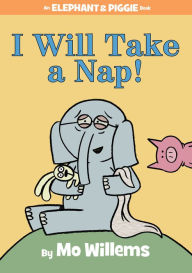
I Will Take a Nap


Willems, M. (2015). I Will Take a Nap! New York, NY: Hyperion Books.

Gerald and Piggie return for another story. Gerald is tired, very tired and cranky. His buddy Piggie decides to join him for a nap but inadvertently keeps Gerald up while he gets rest. But is Gerald really up or was the whole thing a dream? Kids have to look at the illustrations on the page very carefully to catch on to what is happening in the story. 

I enjoy Mo Willems' Elephant and Piggie books. The characters show how friendship has its ups and downs but in the end love for each other wins out. This book is a clever story in that it is a story inside a story. When I read it to my class, they all loved the "turnip head"line. And the surprise ending was pleasing especially to those who figured it out before the story was over.  

Where the Wild Things Are


Sendak, M. (1963). Where the Wild Things Are. New York, NY: Harper & Row.

When you have a "fresh" mouth and are driving your mother crazy, you get sent to your room. This is what happens to Max in this classic children's story. The rest of the tale is Max's imagination. He sails away to an island of true wild things. After they do their best to scare Max, he tames them with a stare in the eyes. They make him their king because truly is is the wildest of them all. The group of them then proceed to go around the jungle being a rowdy bunch. After a while, Max stops the group and send them to bed without supper. Sounds like Max has had some experience with this punishment. He leaves the island and returns to his bedroom to find a hot dinner waiting for him.

Children love this story. Teachers add it to their classroom library and it quickly becomes a favorite. Kids can relate to being sent to their room or time out when all they were doing was having some fun. Adults can relate to having those days when the children are running wild and driving them crazy. This story shows how a writer can take realistic fiction and blend it smoothly with fantasy. It also shows that having a vivid imagination is not thing bad thing.

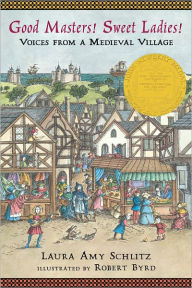
Good Masters! Sweet Ladies! Voices From A Medieval Village


Schlitz, L. (2007). Good Masters! Sweet Ladies! Voices From a Medieval Village. Cambridge, MA: Candlewick Press.

A book of monologues from characters in the Middle Ages. Each speech gives insight on a child's life during this time. There is the nephew of a lord and son of a doctor. On the other end of the spectrum there are speeches from the son of the town's miller and a runaway. The readers also hear from the daughter of a lord and a girl who assaults her out of fit of exhaustion and jealousy. Each speech gives insight on life during that time and how it differs based on the family's position in society but also that there are many things that these kids have in common.

The author writes that she wrote this book so that students at her school could gain an understanding of life during the 1200s. It is essentially a history lesson. The language is true to the time period. Even with footnotes, a lot the words and phrases would be difficult for young children to understand. It is more for students in middle school.

Thursday, April 27, 2017

Balloons Over Broadway: The True Story of the Puppeteer of Macy's Parade


Sweet, M. (2011). Balloons Over Broadway: The True Story of the Puppeteer of Macy's Parade. New York, NY: Houghton Mifflin Books for Children.

A biography written about a man with an unusual but widely known job. The books explains how Tony Sarg became a puppeteer and created one of our most treasured holiday traditions.  When you look at the Macy's Thanksgiving Parade today it is hard to imagine that it started in the mind of one person.  He had and idea and had the gumption to put the idea into action.  Tony grew up creating and moved to London where he began to make puppets. After moving to New York City, he was approached by the owners of Macy's department store and asked to design a window display for the holidays. This turned in to coordinating a parade and eventually a parade of giant balloons. The balloons were made to make it easier for all to see no mater where they sat in the crowd.

This is pleasing biography to read to students during a study on inventors or biographies.The pictures were drawn by author Melissa Sweet. They pages are filled from edge to edge with pictures. There is no wasted white space. This also makes it easy for students to see the pictures no matter where they are sitting in your class. In addition to drawing there are pages with cutouts and photographs of real puppets. The pages are put together like a collage.  The story is also good to show that perseverance an admirable trait.

Wednesday, April 26, 2017

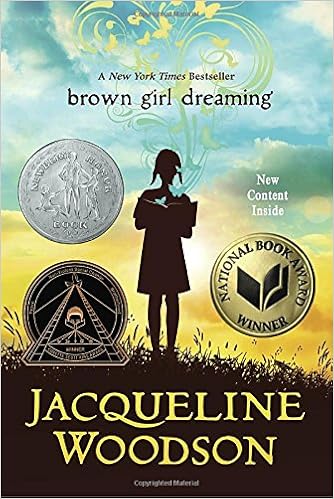
Brown Girl Dreaming


Woodson, J. (2014). Brown Girl Dreaming. New York, NY: Puffin Books.


This book reminds me a little of Crossover since it is written in free verse and autobiographical. It reminds me a little of How I Discovered Poetry since they are both accounts on growing up as black girls in America. Then there was also similarities to The Watsons Go to Birmingham. Both have black families that live in the north and are exposed to new culture when they travel to the south.Also the characters' mothers in both books are originally from the south but have been brought to the north through marriage to raise their families.

Jacqueline Woodson tells the story of being born in Ohio and moving to South Carolina while still very young.  She was raised by her grandparents pretty much while her mother went to New York to try to make a living. Her mother returns with a new baby in tow to bring Jacqueline and her siblings back to New York to live with her. Now they must readjust to living in a big city; much different than the country life they had in South Carolina. She writes of spending her summers down south and returning to New York. She shares stories of learning to read, having her hair pressed, going to church and understanding how African-American were expected to "act" when living in the south as opposed to living up north.  She meets a girl who will become a life long friend and becomes embraced by another family and their culture. She shares about living during the civil rights era as a young child. For her it was hearing about it from family members or on the news not really understanding what the fighting was about. Both because of age and perhaps because of location, New York, she was saved from some of the harsher realities of that time. If she had stayed in South Carolina with her grandparents her experiences would have been different.

I enjoyed this book so much.  It took me a long time to read it and I finally figured out it was because I kept reading the passages over and over again.  It must have been my subconscious not wanting me to stop reading it. This should be on a list for upper elementary or middle school grades. The structure of the story shows students that there is more than just one way to write. The way the tone changes from chapter to chapter and sometimes within a chapter shows students that writing is not one dimensional especially when you are writing about your life. I can see why this book is a National Book Award Winner. It is a wonderful piece. 

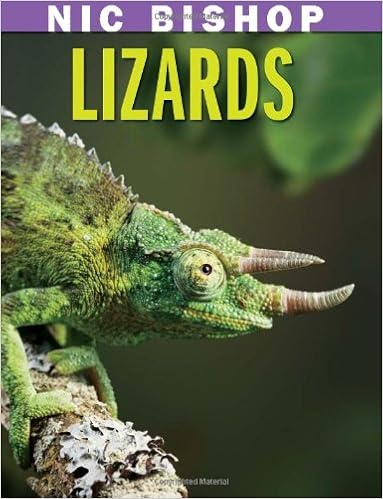
Nic Bishop's Lizards


Bishop, N. (2010) Lizards. New York, NY: Scholastic.

Nic Bishop has written a photographic essay on lizards that would please teachers as well as students. From iguanas to Komodo dragons, there is a plethora of lizards showcased in this book.

First of all the pictures are outstanding.  The tiniest of lizards are zoomed in on so that every detail can be seen. The images spread across a whole page or sometimes two. The colors are bright and monochromatic to really show how the lizards blend in with their environment.  The text does not read like a boring science book. The vocabulary while specific to the domain is not heavy with terms that are too hard for students to decode or use context to decipher. On each page, there is one sentence highlighted with different colored font. Beginning readers could focus on that one sentence and still come away with new knowledge on the family of lizards. 

Squish Deadly Disease of Doom No 7


Holm, J.& Holm, M. (2015). Squish:Deadly Disease of Doom. New York, NY: Random House.

Graphic novels are a favorite for elementary readers. Some can really help with developing comprehension especially in struggling readers. Squish is a series of novels that would be enjoyed by upper elementary students who are looking for a quick fun read. 

Squish is an amoeba. He starts to experience stomach issues one day while at school. This coincides with the characters in his comic book Super Amoeba who are plagued with a mysterious illness. While the readers and Squish's doctor try to figure out what is causing Squish to get sick, Super Amoeba is trying to get to the bottom of what is happening to the citizens of Small Pond. We soon find out that it is Squish's strange combination of Twinkies and orange juice that is causing his stomach to turn. Readers get a quick science lesson on the reaction between acids and bases while reading this.  The Holms also manage to include a quick shout out to their other series Baby Mouse in this story. While the story isn't grand on theme or messaging, it is pleasing for children. My third grader thought it was wonderful and wants to read more. 

Tuesday, April 25, 2017

Rapunzel's Revenge


Hale, S. D. (2008). Rapunzel's Revenge. New York, NY: Bloomsbury.

Rapunzel is kept separate from the world around her by her cold mother Gothel.  One day she sneaks out and sees a dreary village with a long line of people waiting for water. The people look like they have been beaten down by life. They are weak and their clothes are ragged. Rapunzel discovers that her real mother is one of the villagers in line. She was taken away from her when she was younger. Having discovered not only that Gothel lied about being her mother but that she has forced people to work in mines with little food and water, Rapunzel is upset. Gothel orders her taken away from the villa and sends her to a live in a towering tree deep in a far away forest.  When Rapunzel refuses to accept Gothel's life and help her  build their empire, she is forced to stay in the tree for years. Her hair grows and eventually she find a way to escape. She meets up with renegade character, Jack. They travel through the kingdom looking for food, trying to find work to make money, saving kidnapped children, and fighting outlaws.  Soon Rapunzel ends up back at Gothel's villa and a final showdown ends with Gothel losing her powers and being destroyed. Rapunzel saves her mother Kate and her Jack can live in the kingdom worry free.

This is not a typical fairy tale. It is not even the traditional fairy tale with a twist.  This was a whole new story. The only similarities with the familiar Rapunzel story are the character names and the problem of being stuck in a high location.  It seems strange and disjointed to have a story about slaves in a mine and then a charging boar, then a boy with a goose that can lay golden eggs. Then there is a crazy witch man and group of small people who have to fight a giant sea snake.  It didn't make much sense to me. I wouldn't recommend it to a teacher but I could see how adolescents would like it especially since it is written in graphic novel format.

Bridge to Terabithia


Paterson, K. (1977). Bridge to Terabithia. New York, NY: Harper Trophy.

The benefits of friendship is the theme of this novel. Although it was written almost 40 years ago, it's message is still important today. Jess feels unappreciated maybe even unwanted at home. Being the only boy in a house full of girls, it is easy to see how he can feel and even get overlooked. He meets a new friend in Leslie Burke, the new girl at school. They become best friends and create a world for themselves and name it Terabithia. Leslie is pretty much everything Jess is not: rich, a girl, and confident. But as their friendship grows, Leslie encourages growth and confidence in Jess particularly when it comes to his talent in art. Both characters rub off on each other and help those around them like Jess's little sister and the school bully. Unfortunately, Leslie dies in an accident ironically as a result of her fearlessness. Jess comes to term with the loss and finds a new purpose for their "magic" kingdom. He "offers" it to his sister so that she can enjoy it like he and Leslie did.

This is a timeless novel perfect for elementary students age 9-11. Teachers could use it for a read aloud or novel study. The novel has evidence of various types of character conflicts: man vs man, man vs self, even man vs society.  I really like the character Jess.  He is a sensitive young boy that is going through some serious issues but he doesn't act out. This novel shows that you don't have to follow the path that others say you should just because you are a boy or a girl. Just be true to yourself.

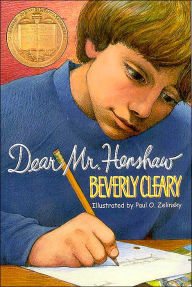
Dear Mr. Henshaw


Cleary, B. (1983). Dear Mr. Henshaw. New York, NY: Harper Trophy

Leigh Botts is a student assigned to write a letter to an author. He choose Mr. Henshaw because he likes his book Ways to Amuse a Dog. He thinks this will be a short assignment not thinking that Mr. Henshaw will write back or will write anything worthwhile. Unfortunately the author answers Leigh's letter with a series of questions. And Leigh's mother makes him answer them much to the boy's frustration. This begins a mentor relationship that Leigh really needs.  The reader soon discovers that Leigh has a tenuous relationship with his father, is dealing with his parents' divorce, and is struggling fitting in to a new school. Henshaw encourages Leigh to start a diary. This helps the boy get his feelings out. Once he begins to express himself, he begins to find ways to solve his problems. 

This novel is a good choice for boys who think they have to be tough and not express their feelings. It is good for all young students to see that others are dealing with family problems like divorce or feeling abandoned. It lets them know they are not alone. There isn't an exciting climax but it is a nice story showing a young boy growing up and maturing. 

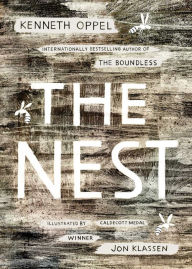
The Nest


Oppel, K. (2016). Nest. New York, NY: Simon and Schuster Books for Young Readers

Reality and dreams are blurred in this suspenseful novel. Steve has a new baby brother. He was born with a serious disability. Around the same time, Steve starts to have dreams about an "angel". Steve's family discovers a wasp nest being built on the house. Soon Steve realizes it is not an angel visiting him in his dreams but the queen wasp. She informs him that she and the worker wasps are going to take his baby and leave a healthy perfect one for his family. Soon Steve realizes that taking his baby brother Theo is not a good idea and tries to stop the plan. However, the moths are determined and Steve's dreams, anxiety, and heroism collide in a thrilling ending.

I admit halfway through this book I wondered how is this considered a children's book. It seems very dark in nature. I thought it would turn out that Steve was bipolar and having a psychotic break. I  was very worried with how the novel would end.  As soon as I finished it my heart was still pounding. After thinking about it, I concluded that students with a taste for thrills might like this but I would caution any student who is very sensitive. 

Tuesday, April 11, 2017

The Watsons Go to Birmingham


Curtis, C ( 1995). The Watsons Go To Birmingham -1963. New York, NY: Yearling.

The United States was a different place in 1963. The southern states still practiced systematic discrimination of people of color. This novel addresses a family raising children during this time. The Watson family consists of a father, mother, their two sons Byron and Kenny and their daughter Joetta. The live in Detroit far away from the hatred in the south. The mom is from Birmingham and still has family there mainly her mother.  In the summer of 1963, the family takes a trip down to Birmingham. The kids experience what southern living is like complete with southern dialects, swimming in lakes, magnolia trees, and the extreme heat.  The trip brings a change in everybody. Byron, who normally is a troublemaker in Detroit, become more respectful and responsible. The mom who usually is the head of the household becomes a daughter again when around Grandma Sands. And Kenny who is usually very dependable begins to get careless and a bit reckless.

A near death experience for two characters change the family forever. The kids experience the ugly side of America and have to decide how to deal with it. The parents have to come to terms with the fact that their children came so close to something they have worked so hard to keep them from. But they realize their family is a lot stronger together than they ever could be if they are separated. They come to understand that they can depend on each other.

This is a fiction story written as a personal narrative. I thought it was an actual biography or memoir. Christopher Curtis includes a real historical event to bring a feeling of reality to the readers.The recollection of this and the response of the characters brings a sense of familiarity to readers who were alive during that time. He uses vivid imagery and quick witted dialogue to bring the setting and characters to life. Teachers can use this novel  to show how to writers use powerful vocabulary in their writing. It can also be included to show how a personal narrative is written 

Mirror Mirror


Singer, M. (2010). Mirror Mirror: A Book of Reversible Verse. New York, NY: Dutton Children's Books.

Rewriting popular fairy tales into poems is a feat. Rewriting them into poems that can be read in reverse is even harder. This book is a collection of verses covering tales like the Princess and the Frog, Cinderella, The Ugly Duckling, and others.  The poems are written two ways. For some poems, the meaning is changed when they are flipped. The illustrations also change depending on which poem you read. For example in "Have Another Chocolate", the poem is written from the perspective of the witch in Hansel and Gretel. When read in reverse, the perspective changes to someone trying to help Hansel trick the witch.

This would be a good book to use in teaching point of view to students. It would also be a fun addition to read during a poetry or fairy tale unit. 

Sunday, April 2, 2017

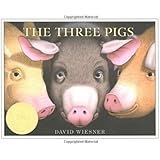
The Three Pigs


Wiesner, D. (2001). The Three Pigs. New York, NY: Clarion Books. 

The three pigs build three houses and the wolf comes and blows the first two houses down and walks up to the third house. Think you know the story? Well the characters in this story choose to change course and leave. The pigs take a paper airplane to new settings and pick up new characters from different stories along the way.

Wiesner's illustrations take the reader through different genres through different scenarios. He cleverly draws pictures to make it look like the pigs are leaving the pages of the book and going into the pages of another. The speech bubbles interjected in the middle of the normal text is an interesting way to show the characters interacting with each other outside of the story. It is a neat way to show the initial story is being interrupted.

Students would like this because it is not what they would be expected. Teachers can use this to teach character insight when they are writing. Or they can use it to teach how to make a surprise ending. 

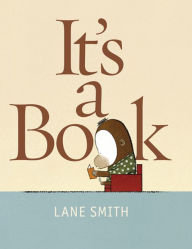
It's a Book


Smith, Lane. (2010). It' a Book. New York, NY: Roaring Brook Press.

In the day of 21st century learners, many feel that the print media will be obliterated. Many children are picking up devices before they are picking up books. Lucky for us and for society the printed media is still thriving. This book takes a slightly humorous look at an encounter between a digital native and a simple paper book. He must be told it doesn't need charging or a password and things do not move around on it. However the rabbit does find out that books are interactive. It is just all done in your mind. 

I would read use it for a read aloud but with some editing; there is one inappropriate word that parents may object to you using with their child. It is a pleasing read nonetheless. 

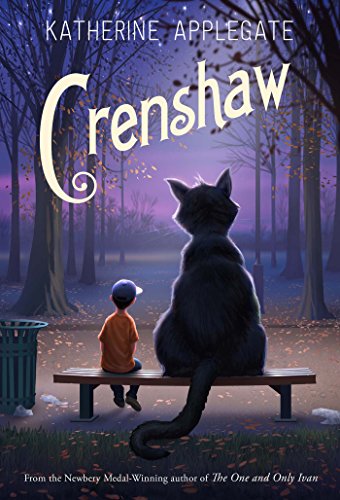
Crenshaw


Applegate, K. (2015). Crenshaw. Harrisburg, VA. Feiwel and Friends.

In Crenshaw, the readers are introduced to Jackson and rather extraordinary cat, Crenshaw. The relationship soon become evident that the cat is Jackson's imaginary friend. The reason why Jackson's friend has appeared now is evident to the reader but not to Jackson. His family is going through a very tough time and Jackson feels like he has to be strong for everyone else but never is honest with himself or others around him. 

The news reports on unemployment and homeless numbers and some specialized shows focus on the adults who have lost their jobs and homes, but there are few reports on how children are affected.  As teachers we have to teach students regardless of what their home life is like. This novel is a reminder of what some of our students have on their plate. They are suffering though tough times to and the one constant in their life is usually school. They may switch school frequently, a fear of the character in this book, but they are usually always enrolled in one eventually. 

This is good book for upper elementary students. This novel could lead to classroom discussions on how to open up and express their feelings.  Teachers and counselors could use to teach compassion and build empathy in students. 

Crossover


Alexander, K. (2014). Crossover. New York, NY: Houghton Mifflin Harcourt.

Josh and Jordan (JB) Bell are twin brothers, the sons of former Professional European basketball player Charles (Chuck) "Da Man" Bell. They are preteens who have done pretty much everything together and are all the sudden growing apart. While they both love basketball, other things start to become just as important as it does with most boys. Other things like girls, love, crushes, and jealousy. Another theme throughout the book  is trust. Without giving too much away the narrator and his father both must deal with some trust issues to be able to heal fractures that are starting in the family unit.

The story is written in free verse prose. Kwame Alexander uses the voice of a preteen African American boy to produce a wonder story on family love and growing up.  You do not have to love basketball to appreciate this book and be moved to tears.